

You begin working on a problem that requires careful thought. After a few minutes, a message notification appears. You pause to respond. Then a calendar reminder pops up. Shortly after, another message arrives asking for quick input.
Each interruption seems small. Responding only takes a moment.
But when you return to the original task, something feels different. The thread of thought is gone. You need a few minutes to reconstruct where you were and what you were trying to solve.
Over the course of a day, these interruptions accumulate.
The result is a workday full of activity but very little sustained thinking.
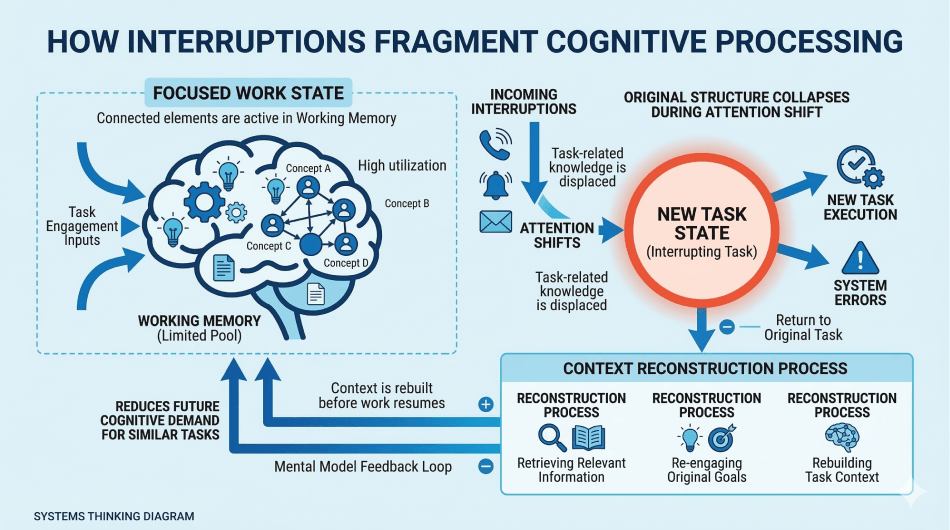
Systems Layer
Attention operates as a sequential processing system. At any given moment, cognitive resources are focused on a limited set of active elements within working memory.
Deep thinking tasks — such as analysis, design, or complex problem solving — require sustained activation of multiple interacting elements over time.

Within the Cognitive Load pillar, high-performing environments protect cognitive capacity by reducing interruption frequency and preserving uninterrupted thinking windows.
When attention remains stable long enough for ideas to connect, the system can sustain complex reasoning rather than constantly restarting it.
