

Systems rarely collapse without warning.
Before a major failure occurs, smaller signals often begin to appear. Decisions take slightly longer than usual. Communication becomes less precise. Small mistakes start showing up in places where they normally would not.
Individually, these signals can seem minor. They are easy to dismiss as temporary stress, a busy week, or a difficult project.
But taken together, they often reveal something structural.
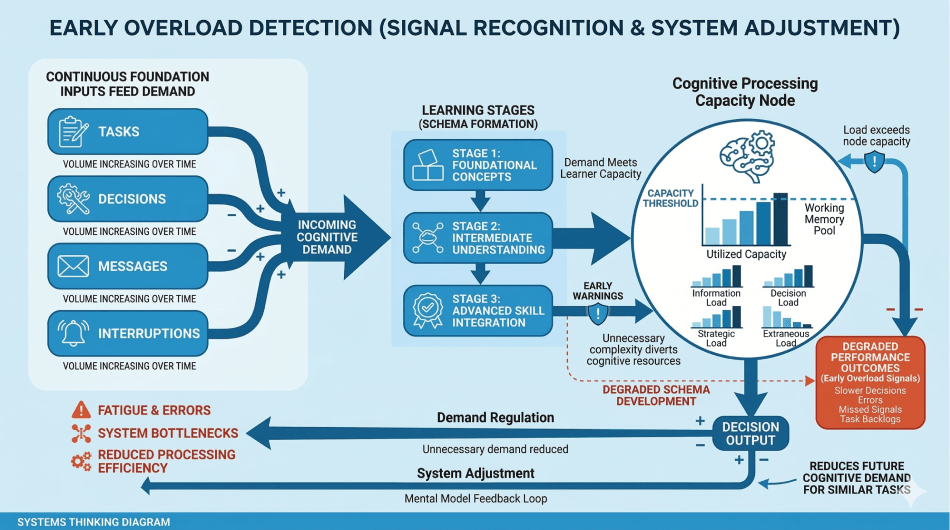
The system may be operating beyond its processing capacity.
Systems Layer
Overload occurs when the incoming demand placed on a system exceeds its available processing capacity.
In cognitive systems, this demand includes tasks, decisions, information signals, and interruptions that must be interpreted and acted upon.

When organizations respond early by adjusting demand, clarifying priorities, or redistributing load, they restore system stability before deeper failures occur.
Monitoring these signals protects both performance and human capacity.
