

When work is distributed across many people, teams, or external partners, coordination becomes more complex.
Each role focuses on its own tasks. Each team optimizes its own workflow. External contributors complete the assignments they receive.
From the perspective of each individual role, the work may appear successful.
Yet the overall system can slowly drift away from its intended priorities because no shared direction is guiding how those individual efforts fit together.
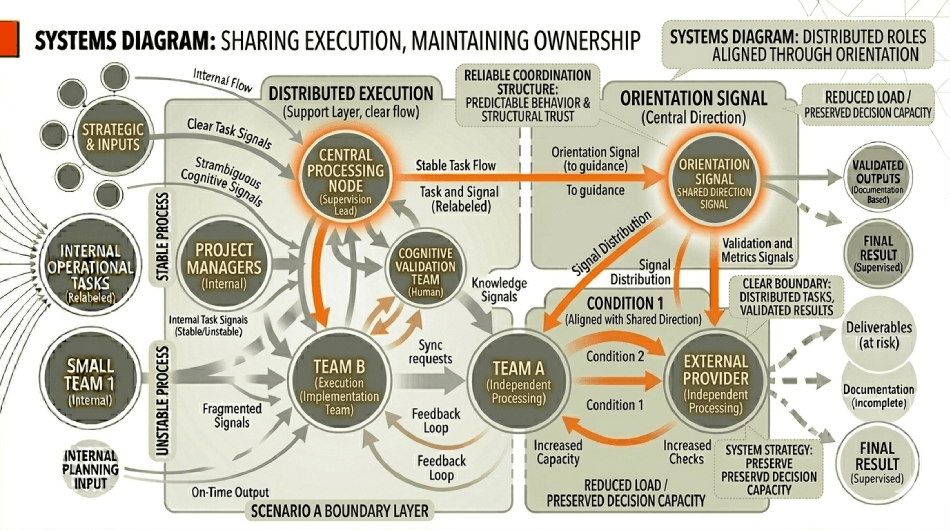
Systems Layer
Distributed systems require orientation signals to maintain alignment.
Orientation defines the direction of the system—its priorities, objectives, and criteria for success. These signals guide how individual nodes interpret tasks and make local decisions.

When roles across the system understand the same priorities and objectives, distributed execution can occur without losing alignment.
Orientation allows complexity to expand while keeping the system moving in a coherent direction.
