
When teams begin distributing work, the goal is usually simple: reduce overload and allow more people to contribute.
Tasks move across roles, responsibilities expand to new contributors, and sometimes external partners become involved. On the surface, the workload appears to be shared.
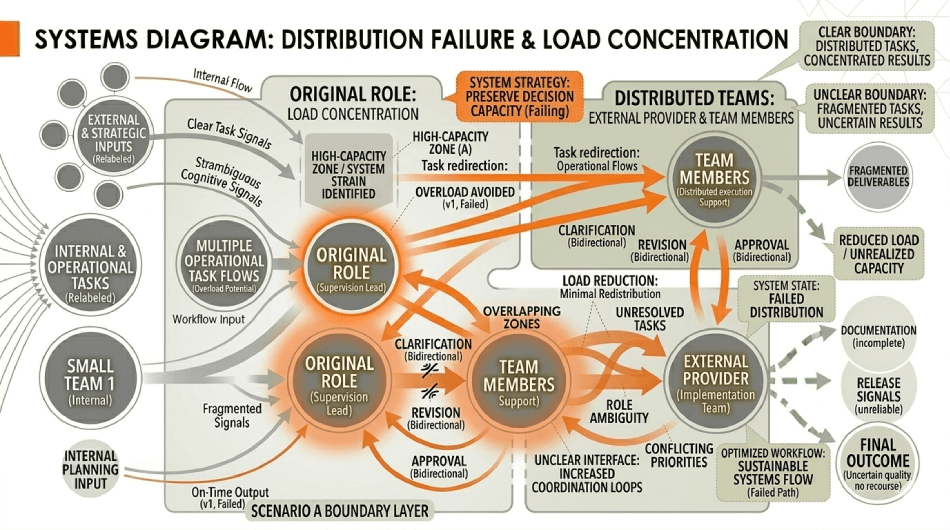
But over time, subtle signals begin to appear. Certain people remain overwhelmed. Questions repeatedly return to the same individuals. Work seems to circulate between roles without actually progressing.
The system has technically distributed tasks—but something about the distribution is not working.
Systems Layer
Load distribution functions properly when operational tasks move to nodes that can process them independently.
Each node must receive sufficient signals—context, expectations, and decision boundaries—to process the load without continuous reattachment to the originating node.

When tasks move through the system with minimal recirculation, load has been structurally redistributed rather than simply reassigned.