

Content is not just a collection of posts.
It is a system of attention, trust, education, timing, repetition, and conversion.
Systems Literacy for Content Strategy means learning to read how those parts interact before deciding what to publish next.
Strong creators do not only make content. They build ecosystems where each idea supports the next, each signal teaches the audience, and each touchpoint helps attention move toward belief.
Random Posts Create Random Movement
Most content strategies fail because they treat every post as an isolated event.
A creator shares a thought, launches a thread, records a video, sends an email, or publishes an article, then measures the result one piece at a time.
Did it get views? Did it get clicks? Did it convert?
But content rarely works through single moments alone.
Trust builds through repetition. Education builds through sequence. Conversion builds through readiness. Timing shapes whether the audience can receive the message.
A post that underperforms may not be weak. It may be disconnected from the system around it.
A strong idea can disappear when it has no rhythm, no reinforcement, and no path to follow.
That is how attention leaks.
The audience may notice one piece, but without connection to the next idea, signal, or step, the movement stops there.
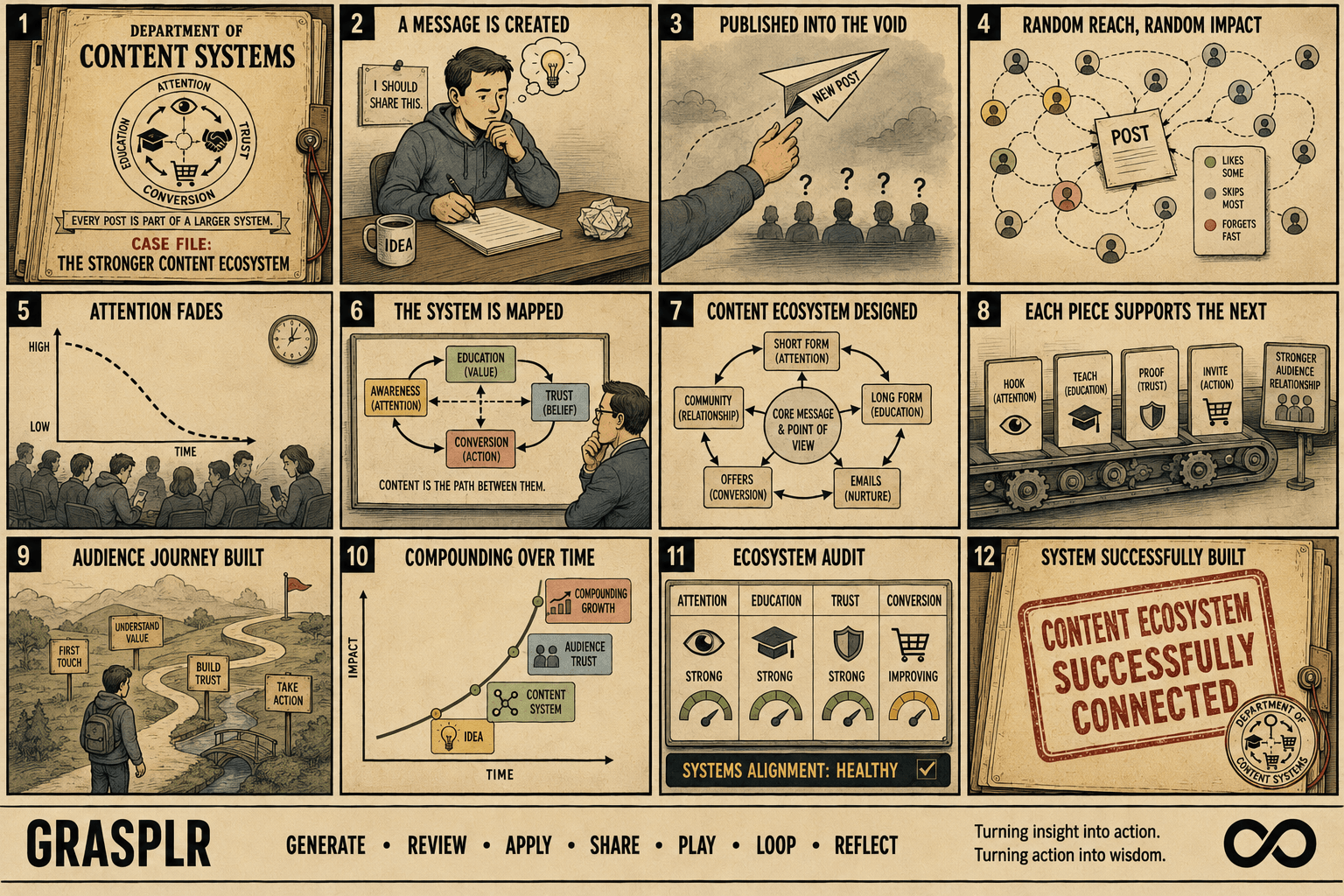
Content System Literacy as Ecosystem Design
Content System Literacy is the ability to understand how content elements interact to produce audience behavior.
It asks you to read the relationship between attention, trust, education, timing, repetition, and conversion instead of treating each asset separately.
Think of it as designing a living content environment.
Attention brings people into the system. Trust gives them a reason to stay. Education helps them understand the value. Timing determines when the message lands. Repetition makes the idea familiar. Conversion gives the relationship a next step.
Each part changes the effect of the others.
Attention without trust becomes temporary. Trust without education can stay vague. Education without timing can overwhelm. Repetition without variation becomes noise. Conversion without readiness feels abrupt.
This shifts the question from “What should I post today?”
You begin asking, “What movement does this content system need to create?”
Reading the Forces Inside Your Content Ecosystem
To build stronger content strategy, look at the system your audience is actually experiencing.
Each part should help attention move with more clarity.
- Attention paths: Notice what draws people in and where their focus drops. Strong content systems create entry points without leaving the audience stranded.
- Trust signals: Study what makes your voice, promise, and perspective feel reliable over time. Trust grows when ideas, tone, proof, and delivery stay coherent.
- Education sequences: Arrange content so the audience learns in layers. People need repeated bridges from problem awareness to deeper understanding.
- Timing rhythms: Match content depth to audience readiness. Lightweight ideas may open attention quickly, while heavier insights need slower cadence and more context.
- Repetition loops: Repeat core ideas through different angles, examples, and formats. Repetition is not redundancy when it strengthens recognition.
- Conversion bridges: Create clear pathways from insight to action. Conversion should feel like the next natural step in the relationship, not a sudden demand.
When these forces are visible, content becomes easier to design.
You stop asking each post to do everything and start giving each piece a role in the larger system.
Strong Content Works Because the System Works
Systems Literacy turns content strategy from output management into ecosystem design.
It teaches that posts, emails, videos, articles, and offers are not separate pieces of work. They are connected signals shaping what the audience notices, understands, trusts, remembers, and chooses.
When you read your content system, you can see where attention leaks, where trust needs reinforcement, where education is missing, where timing is off, and where conversion feels disconnected.
You can build content that does more than appear consistently.
You can build content that compounds.
A single post may capture attention.
A content system teaches attention where to go next.
