
The Hidden Structures That Make Trust Possible
Trust feels personal, but it is often structural. We trust brands we’ve never met, systems we’ve never inspected, and institutions we barely understand. We hand over passwords, sign contracts, board airplanes, and transfer money because invisible mechanisms convince us that risk is being managed.
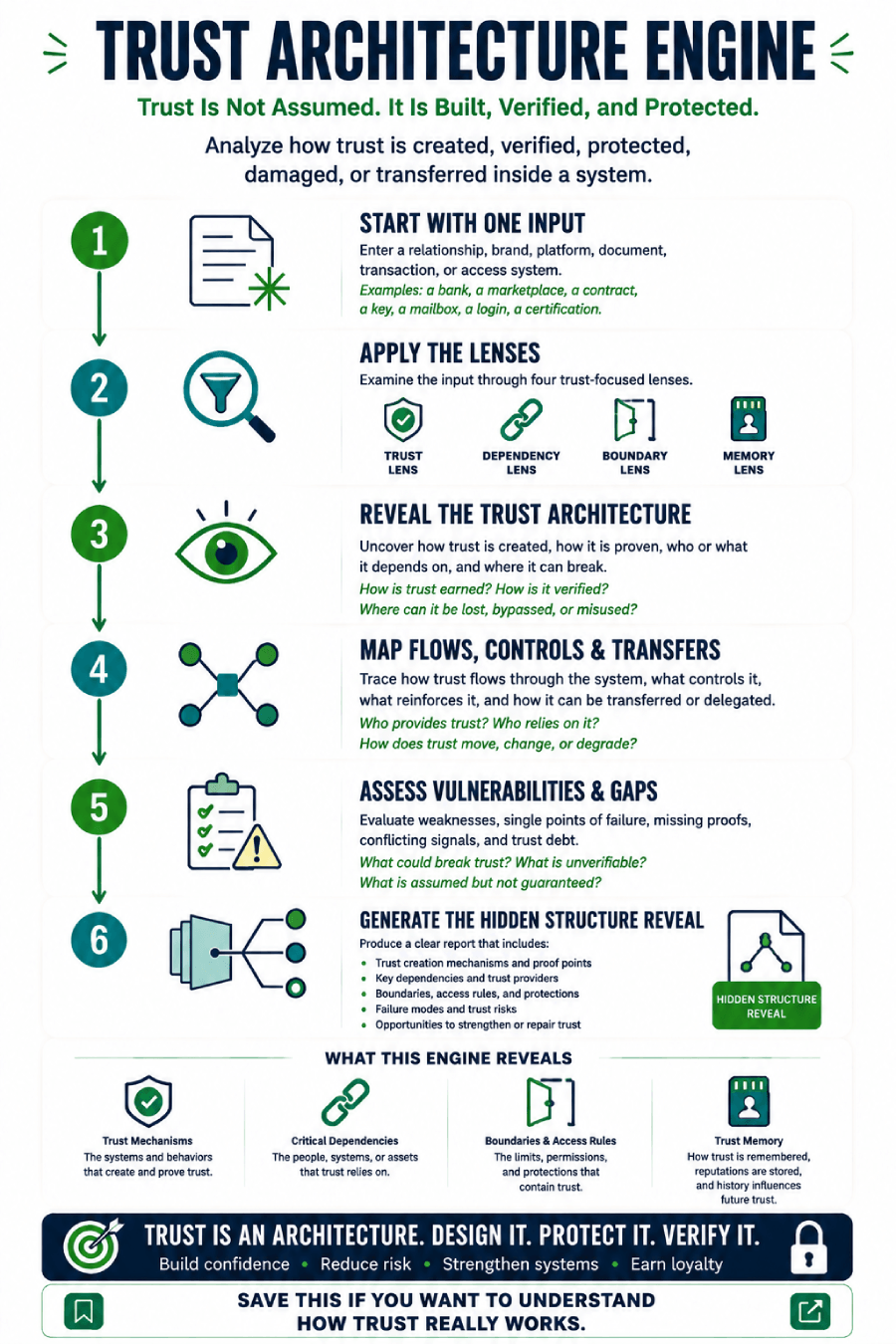
The Trust Architecture Engine reveals how trust is created, verified, protected, damaged, and transferred within a system. What appears to be confidence is often the result of carefully designed architecture operating beneath the surface.
Trust Is Not a Feeling—It Is a System
Most people think trust begins with belief.
A customer trusts a brand. A citizen trusts an institution. A user trusts a platform. A friend trusts a promise.
While trust is experienced emotionally, it is usually sustained structurally.
Behind every trusted relationship are mechanisms that reduce uncertainty. Verification processes confirm identities. Boundaries control access. Records preserve accountability. Dependencies ensure consistency. Together, these structures create conditions where trust can exist at scale.
Without those mechanisms, trust becomes fragile because it relies entirely on individual judgment.
The larger the system, the more architecture is required to support trust.
Trust Architecture Engines Reveal the Structures Behind Confidence
A Trust Architecture Engine is a framework for analyzing how trust operates inside a relationship, brand, platform, document, transaction, or access system.
Instead of asking, “Do people trust this?” it asks, “What makes trust possible here?”
This shift uncovers the hidden structure beneath confidence.
A key is not simply a piece of metal—it is a trust transfer mechanism. A contract is not merely a document—it is a trust preservation system. A brand is not a logo—it is accumulated evidence stored in memory. A password is not security—it is a verification control inside a larger trust architecture.
Trust is rarely created by declarations. It is created by systems that make reliability believable.
Conducting a Hidden Structure Reveal
To uncover how trust functions within a system, examine it through four lenses:
- Trust Lens: How is confidence earned, established, or reinforced over time?
- Dependency Lens: What supporting systems, behaviors, or actors must remain reliable for trust to continue?
- Boundary Lens: What controls access, limits risk, or separates trusted participants from untrusted ones?
- Memory Lens: What records, signals, experiences, or evidence preserve trust across time?
As these perspectives accumulate, a Hidden Structure Reveal begins to emerge.
The analysis exposes:
- How trust is initially established
- How trust is verified and maintained
- Where trust can be damaged or exploited
- How trust is transferred between people, systems, or institutions
- Which structures protect trust from erosion
What appeared to be confidence reveals itself as architecture.
Every Trusted System Contains Verification Mechanisms
Trust is often strongest when it is least visible.
Customers rarely think about quality controls until a product fails. People rarely think about security systems until a breach occurs. Citizens rarely think about institutional safeguards until they are tested.
The Trust Architecture Engine makes these hidden structures visible. It reveals that trust is not a static asset but a continuously maintained system of verification, boundaries, memory, and dependency management.
The most trusted organizations are not necessarily those that ask for trust. They are those that build architectures capable of earning and protecting it.
When you learn to see trust this way, every relationship, brand, platform, and institution becomes more understandable. You stop asking who is trusted and start asking how trust is being produced. And once the architecture becomes visible, so do its strengths, weaknesses, and vulnerabilities.
Because trust is never just belief. It is a system designed to make belief possible.