
Understanding How Change Actually Happens
People often focus on beginnings and endings. They celebrate success, analyze failure, and compare the starting point to the final result. What gets overlooked is the transformation itself—the stages, thresholds, constraints, and reinforcing forces that make change possible.
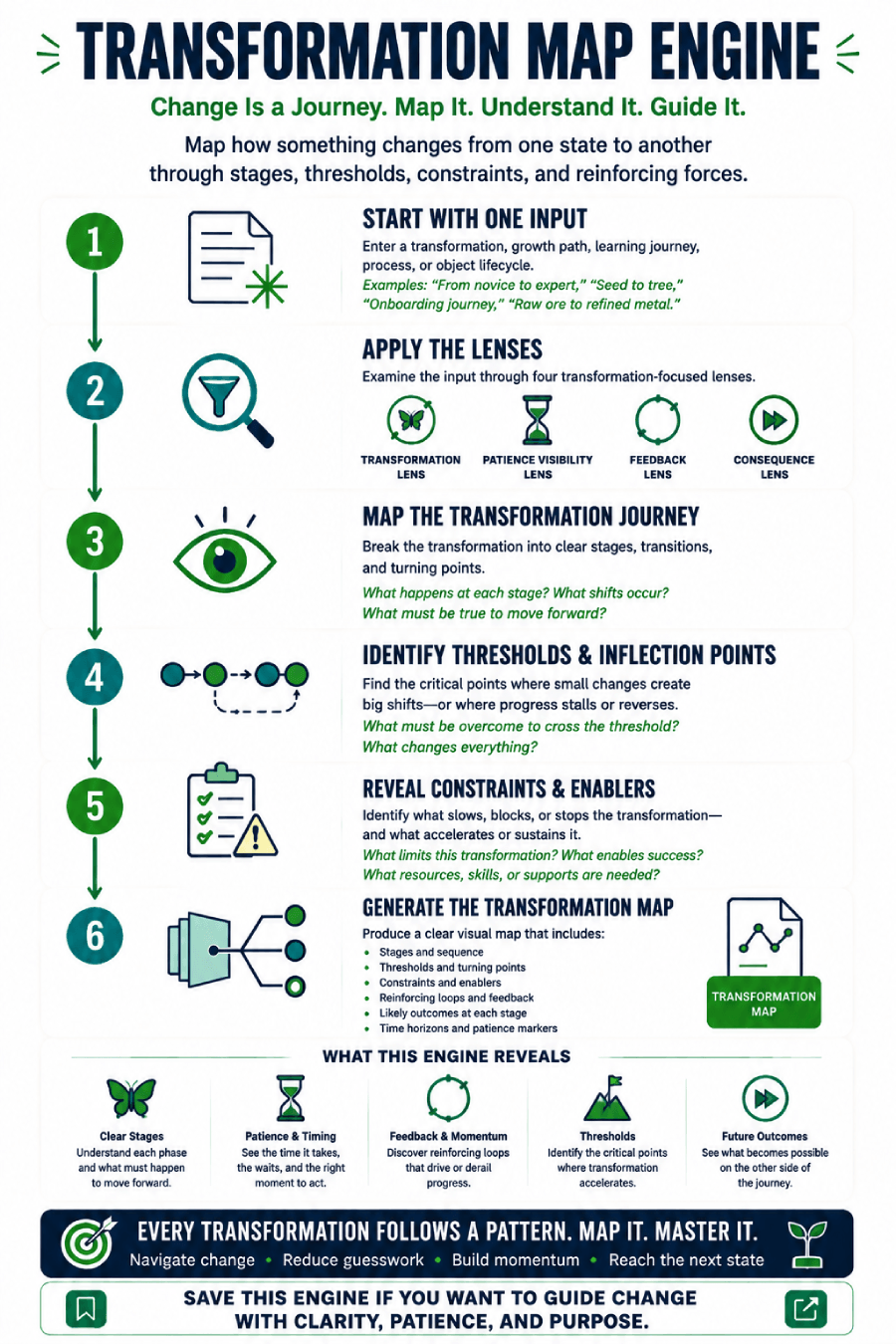
The Transformation Map Engine reveals the hidden journey between states, showing that transformation is rarely a single event. It is a structured process that unfolds through predictable patterns of growth, resistance, adaptation, and reinforcement.
Most Transformations Look Sudden Only in Retrospect
A thriving business appears to emerge from nowhere. Expertise seems to arrive effortlessly. Confidence looks natural. A mature ecosystem appears stable. A finished product feels complete.
Yet every transformation contains a long period of invisible development.
Skills accumulate before mastery becomes visible. Trust grows before relationships feel secure. Systems evolve before their capabilities become obvious. Trees spend years developing roots before reaching impressive heights.
Because observers typically notice only the visible stages, transformation is often mistaken for an event rather than a process.
This misunderstanding creates unrealistic expectations. People expect outcomes without appreciating the thresholds required to reach them.
Transformation Map Engines Reveal the Journey Between States
A Transformation Map Engine is a framework for understanding how something changes from one condition to another through stages, constraints, feedback loops, and reinforcing forces.
Instead of asking, “What changed?” it asks, “How did the change become possible?”
This shift exposes the architecture of transformation.
A beginner becoming an expert is not simply gaining knowledge. It involves repeated practice, feedback cycles, moments of frustration, threshold breakthroughs, and gradual identity shifts. A startup becoming a mature company is not simply growth. It is a sequence of adaptations, constraints, opportunities, and organizational transformations.
Every meaningful change follows a path.
The map reveals that path.
Building a Flow Diagram
To understand a transformation, examine it through four lenses:
- Transformation Lens: What stages separate the starting state from the desired future state?
- Patience Visibility Lens: Which important changes occur before visible progress becomes apparent?
- Feedback Lens: What signals accelerate, reinforce, or redirect the transformation?
- Consequence Lens: What new capabilities, limitations, or responsibilities emerge at each stage?
As these perspectives combine, a Flow Diagram begins to emerge.
A typical transformation map identifies:
- The starting state
- Transitional stages
- Critical thresholds
- Common constraints and resistance points
- Reinforcing mechanisms that sustain momentum
- The resulting state
The focus shifts from outcomes to pathways.
Growth Happens Through Thresholds, Not Straight Lines
One reason transformation feels difficult is that progress is rarely linear.
Long periods of effort may produce little visible change. Then a threshold is crossed and progress suddenly becomes obvious. Learning works this way. Relationships work this way. Businesses work this way. Natural systems work this way.
Transformation often resembles cultivation more than construction.
You do not force the outcome. You create the conditions that allow the outcome to emerge.
The Transformation Map Engine helps make those conditions visible. It reveals that growth is not simply movement from point A to point B. It is the navigation of stages, constraints, feedback loops, and thresholds that gradually reshape a system.
When you can see the map, patience becomes easier. Setbacks become understandable. Progress becomes measurable.
Because transformation is rarely mysterious. It is usually a process whose structure has not yet been revealed.