
Revealing the Hidden Operating System Behind Human Behavior
People often appear inconsistent on the surface.
Their projects change. Their interests evolve. Their language shifts. Their careers take unexpected turns.
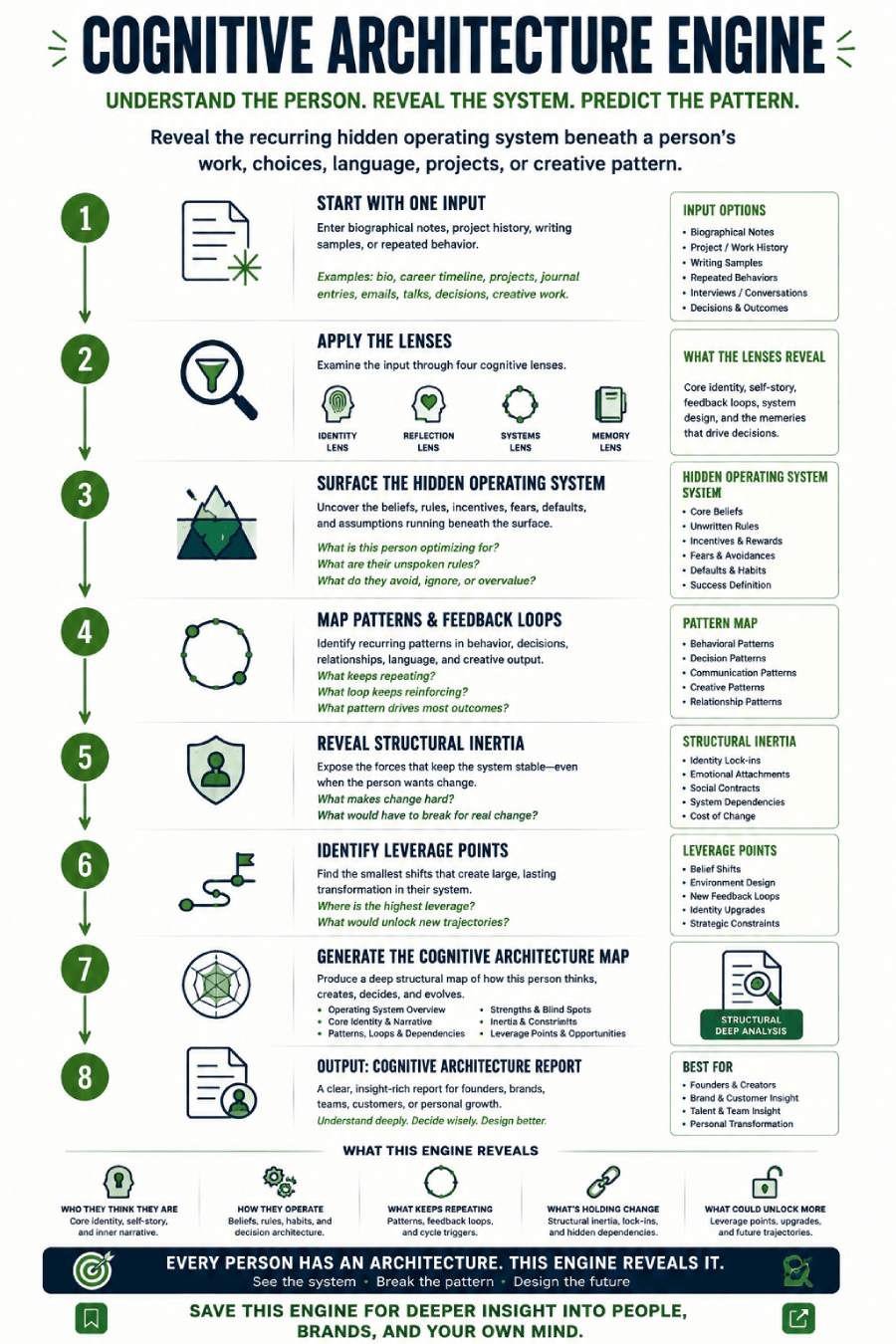
Yet beneath this apparent variety, most individuals operate from a surprisingly stable cognitive architecture—a recurring system of assumptions, values, patterns, and mental models that quietly shapes how they think, create, decide, and act. The Cognitive Architecture Engine uncovers that hidden operating system, revealing the deeper structure connecting seemingly unrelated choices and behaviors.
Surface Behavior Often Hides Deeper Consistency
Most analysis focuses on visible actions.
People examine what someone built, what they said, what they purchased, what they launched, or what they chose.
But behavior is often the output of something deeper.
A founder repeatedly creates marketplaces rather than products. A writer continually explores themes of uncertainty and meaning. A leader consistently optimizes for autonomy over efficiency. An artist returns to the same emotional territory across different mediums.
The projects may differ.
The architecture remains remarkably consistent.
What appears to be a collection of choices is often the expression of a recurring internal system.
Cognitive Architecture Engines Reveal the Hidden Pattern
A Cognitive Architecture Engine is a framework for identifying the underlying operating system expressed through a person’s work, decisions, language, projects, and repeated behaviors.
Instead of asking, “What have they done?” it asks, “What pattern keeps generating these outcomes?”
This changes the focus from events to structure.
A person’s career becomes a sequence of experiments driven by the same underlying motivations. Their writing becomes evidence of recurring cognitive priorities. Their projects become manifestations of deeper questions they continually revisit.
The goal is not personality analysis.
The goal is structural analysis.
The engine seeks the hidden architecture that explains why certain choices feel natural, why specific problems attract attention, and why particular themes repeatedly emerge.
Conducting a Structural Deep Analysis
To uncover a person’s cognitive architecture, examine their history through four lenses:
- Identity Lens: What values, priorities, or self-concepts consistently appear across different contexts?
- Reflection Lens: What recurring questions, tensions, or fascinations seem to drive their thinking?
- Systems Lens: What types of structures, patterns, or problems do they naturally gravitate toward?
- Memory Lens: Which experiences, lessons, successes, or failures continue to influence present behavior?
As these patterns accumulate, a Structural Deep Analysis begins to emerge.
The analysis reveals:
- Recurring themes across projects and decisions
- Core assumptions driving behavior
- Preferred problem-solving approaches
- Hidden motivations and priorities
- Structural patterns that persist across time
What initially appears to be a collection of events becomes a coherent system.
People Build Variations of the Same System
One of the most surprising discoveries is that many people spend decades expressing the same core architecture through different forms.
The entrepreneur builds companies around a recurring obsession. The writer explores the same question through different stories. The researcher investigates variations of a central mystery. The creator repeatedly returns to a particular way of seeing the world.
The medium changes.
The operating system remains.
The Cognitive Architecture Engine exists to make that operating system visible. It reveals that identity is often less about who someone says they are and more about the recurring patterns hidden within what they repeatedly create, pursue, and prioritize.
Because beneath every body of work is a deeper structure.
And once that structure becomes visible, individual actions stop looking random. They begin to look inevitable.
Structural Deep Analysis
Every Cognitive Architecture Engine assessment should uncover:
Recurring Pattern: What repeatedly appears across work, choices, and behavior?
Core Operating Principle: What belief or assumption seems to drive decision-making?
Persistent Fascination: Which themes, questions, or problems continuously attract attention?
Structural Inertia: What pattern continues to reproduce itself over time?
Hidden Identity System: What deeper architecture explains the person’s body of work?
The strongest insights do not explain what a person has done. They reveal the invisible system that keeps producing what they do.