
Turning Ordinary Objects Into Compressed Insight
Most people see objects. Systems thinkers see revelations.
A key becomes a lesson about trust. A bridge becomes a lesson about connection. A calendar becomes a lesson about memory.
A lock becomes a lesson about boundaries. The object itself is rarely the most interesting thing about it. What matters is the hidden system, principle, and question embedded within its existence.
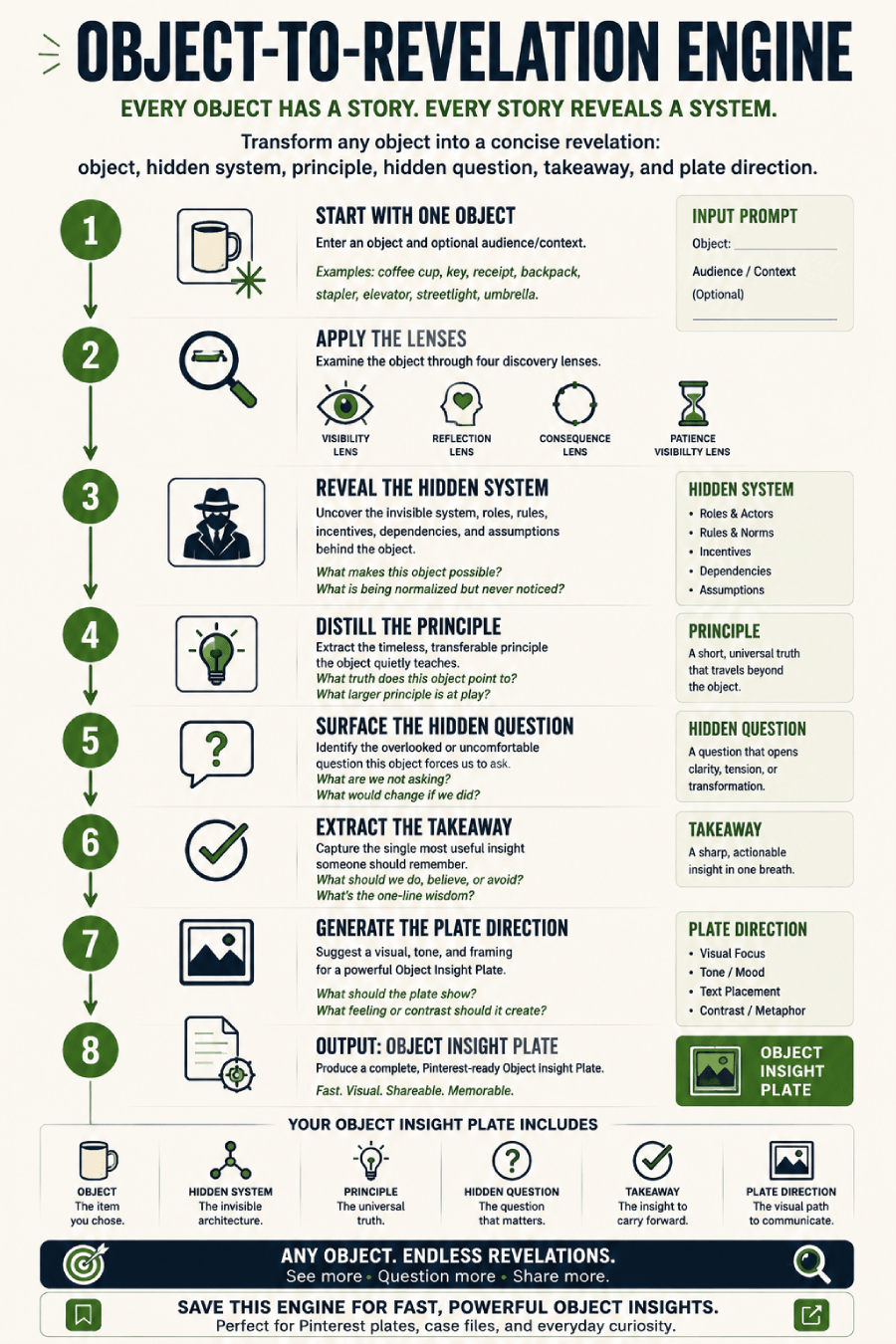
The Object-to-Revelation Engine compresses an everyday object into a highly portable insight structure, transforming physical artifacts into memorable revelations that can be shared, taught, visualized, and reused. Instead of producing a deep analysis, it produces a concise insight package designed for rapid understanding and visual content creation.
Objects Are Evidence of Solved Problems
Every object exists because someone encountered a recurring challenge.
A ladder exists because height creates barriers. A mailbox exists because communication requires trusted delivery. A map exists because navigation is difficult. A battery exists because energy must be stored before it can be used.
The object is the visible solution.
The hidden problem is the revelation.
Most people interact with objects without ever considering the conditions that made them necessary. As a result, the deeper lesson remains invisible.
The Object-to-Revelation Engine exists to uncover that lesson quickly.
Object-to-Revelation Engines Compress Meaning Into Portable Insight
An Object-to-Revelation Engine transforms an object into six connected layers:
- Object: The visible artifact.
- Hidden System: The invisible structure the object depends upon or represents.
- Principle: The enduring truth embedded within the object’s function.
- Hidden Question: The deeper question the object quietly asks.
- Takeaway: The compressed insight worth remembering.
- Plate Direction: A visual framing designed for content creation and rapid communication.
The result is not an explanation of the object.
The result is a revelation generated by the object.
Building an Object Insight Plate
To create a revelation, examine the object through four lenses:
- Visibility Lens: What hidden problem becomes visible because this object exists?
- Reflection Lens: What does this object reveal about human behavior or decision-making?
- Consequence Lens: What would happen if this object or its function disappeared?
- Patience Visibility Lens: What invisible effort, process, or history was required before this object became ordinary?
These questions quickly reveal the deeper structure beneath the artifact.
The object becomes a doorway into a larger idea.
Small Objects, Large Revelations
The most powerful insights are often hiding inside the most ordinary things.
A key reveals trust.
A mirror reveals self-perception.
A receipt reveals accountability.
A queue reveals fairness.
A fence reveals boundaries.
A bookmark reveals interrupted attention.
The Object-to-Revelation Engine trains people to look beyond utility and see meaning. It transforms physical objects into compressed frameworks for understanding systems, behavior, incentives, and human nature.
Because every object is more than a thing.
It is evidence that a problem existed, a solution emerged, and a lesson remains hidden inside.
Object Insight Plate
- Object: What are we looking at?
- Hidden System: What invisible structure does it reveal?
- Principle: What enduring truth does it embody?
- Hidden Question: What deeper question does it invite?
- Takeaway: What is the compressed insight?
- Plate Direction: How should the revelation be visualized or framed?
The strongest object revelations do not explain the object. They explain the world the object quietly exposes.