12% Off Everything ⚡ Limited-Time Sitewide Savings
Pattern Dynamics – How Systems Theory Reveals the Hidden Structures Behind Every Outcome
GRASPLR SYSTEMS LITERACY
Pattern Dynamics – How Systems Theory Reveals the Hidden Structures Behind Every Outcome
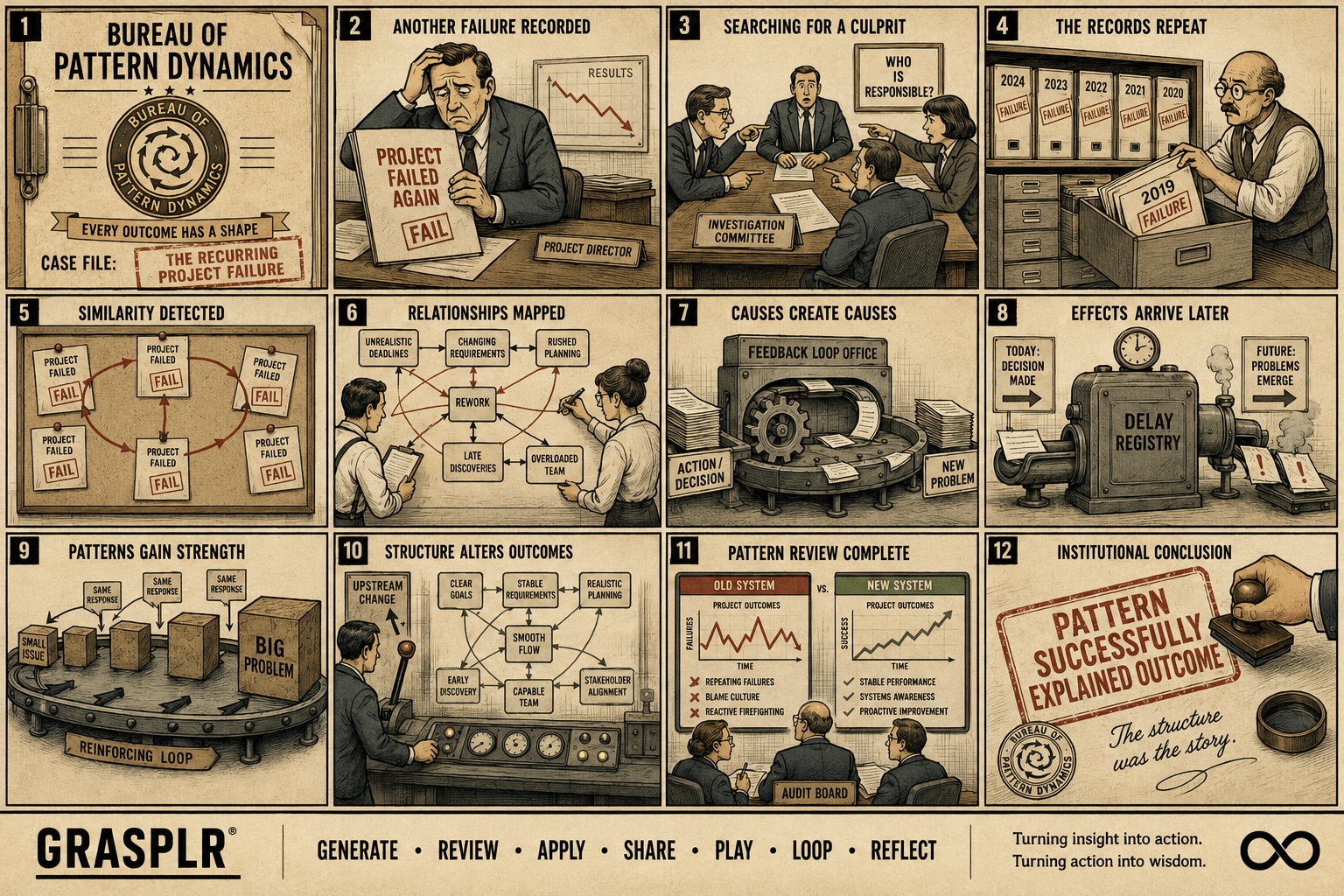
Most people experience events as isolated incidents—a missed deadline, a market shift, a customer complaint, a breakthrough success. Systems Theory challenges that perspective by revealing a deeper reality: outcomes rarely emerge from single causes. They arise from networks of interconnected forces influencing one another over time. What appears random on the surface is often the predictable result of underlying patterns. Understanding those patterns allows us to move beyond reacting to events and begin shaping the systems that create them.
Events Distract Us from the Patterns Beneath Them
When problems appear, the natural response is to focus on the immediate symptom. If sales decline, we launch a campaign. If engagement drops, we publish more content. If productivity slows, we add new processes. These reactions target visible events rather than the structures producing them. The challenge is that systems generate recurring behaviors. Unless the underlying relationships change, the same outcomes eventually return. People often mistake repetition for coincidence when it is actually the system expressing its design.
Pattern Dynamics and the Logic of Interconnection
Pattern Dynamics is the principle at the heart of Systems Theory: behavior emerges from relationships, not isolated components. Every system—whether an organization, community, market, or content ecosystem—contains interconnected elements that continuously influence one another. Feedback loops reinforce or balance activity. Delays distort perception. Incentives shape behavior in unexpected ways. Over time, these interactions create recurring patterns that become visible in results.
Rather than asking, “What caused this event?” Systems Theory asks, “What pattern produced this outcome?” The shift is subtle but transformative. It redirects attention from individual moments to the structures that make those moments likely.
Learning to See Systems Instead of Events
Developing a systems perspective requires looking beyond immediate circumstances and identifying recurring relationships. Focus on three layers:
Events: The visible outcomes people notice first—successes, failures, spikes, and disruptions.
Patterns: Repeated trends that connect multiple events across time.
Structures: The underlying rules, relationships, incentives, and feedback loops generating those patterns.
When a pattern appears repeatedly, resist the urge to search for a new explanation each time. Instead, examine the structure supporting it. Systems reveal themselves through consistency, not exceptions.
Beyond the Deadline: Explore Pattern Dynamics
Use one recurring deadline problem to move from noticing events to investigating, redesigning, and evaluating the system behind them.
The Box takes you from spotting a recurring deadline pattern to testing and evaluating a possible structural change—without assuming that a plausible explanation is already proven.
Understanding Patterns Creates Better Decisions
The value of Systems Theory is not prediction—it is perception. The more clearly you see relationships, the more effectively you can influence outcomes. Instead of reacting to every fluctuation, you learn where leverage exists. Small structural adjustments can produce effects far greater than repeated tactical responses. Over time, this perspective transforms problem-solving into system-shaping. When you understand Pattern Dynamics, you stop chasing symptoms and start redesigning the conditions that create them.
The GRASPLR Blogosphere
Systems, scenes, and structures in motion.
I’ve spent years building systems — some for clients, some just to keep my own chaos in check.
This blog is where I share what I’ve learned: how structure can sharpen creativity, and how smart systems make ideas grow.