Situated Human Judgment – Why Context Still Matters in Systems Built for Consistency

Situated Human Judgment preserves the role of context inside structured systems. It gives people defined room to interpret circumstances that rules alone cannot fully anticipate.
The choice is not between rigid process and individual instinct. The goal is to build a system that knows where consistency is useful and where context requires interpretation.
Rules Lose Resolution at the Edges
Policies work best when situations resemble the conditions they were designed for. Real environments are less predictable.
Audiences shift. Context changes. Exceptions emerge. A decision that makes sense in one moment can produce the wrong effect in another, even when the underlying rule remains unchanged.
This is where rigid systems lose resolution. Generalized rules continue operating as circumstances become more specific. The process remains consistent, but the outcome becomes less connected to the situation.
The problem isn’t the rule. It’s assuming the rule can see everything.
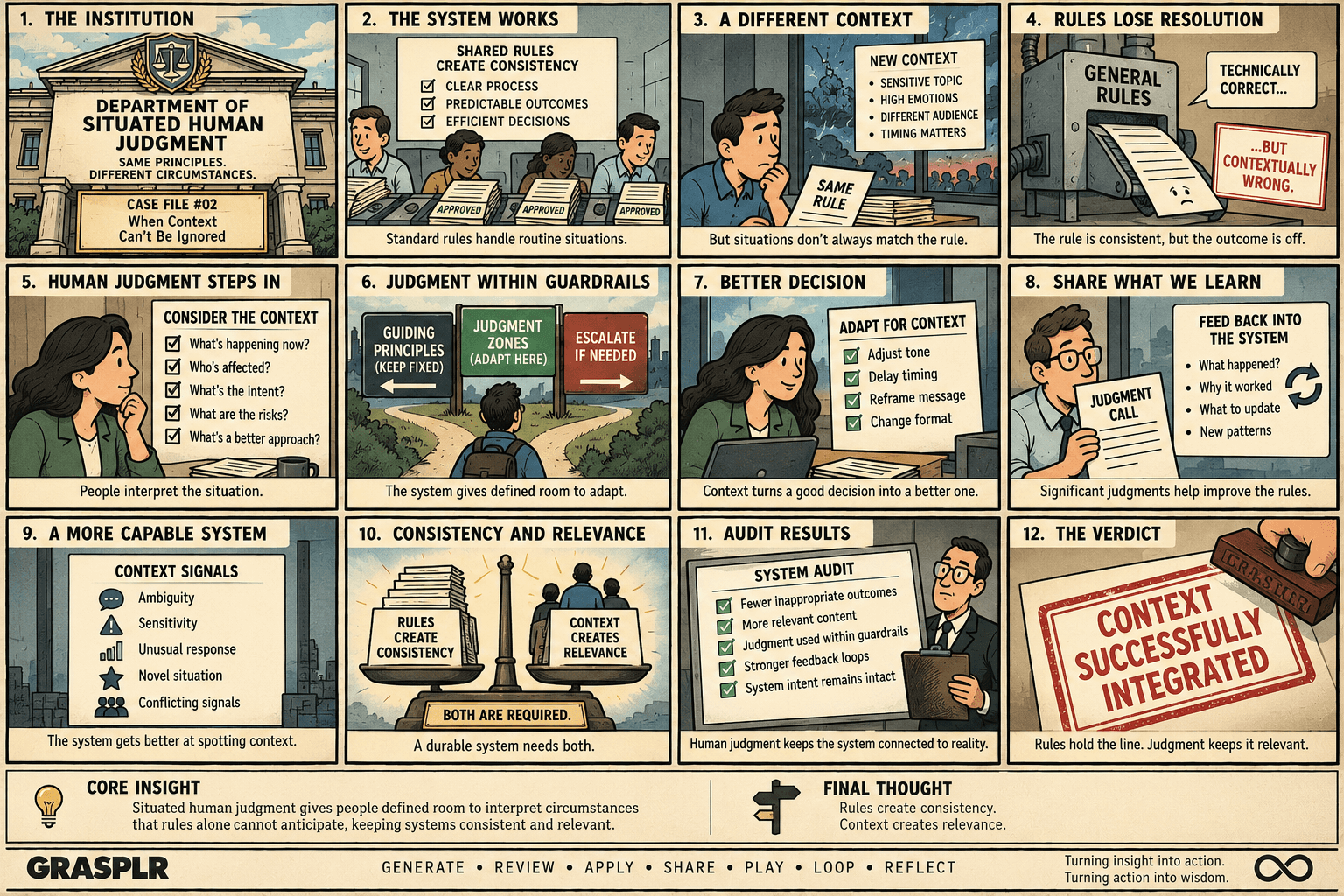
Situated Human Judgment as Contextual Intelligence
Situated Human Judgment is the ability to interpret a decision from within the circumstances surrounding it, rather than relying only on the framework governing it.
It acts as a contextual layer between policy and action. The system establishes principles, boundaries, and defaults. Human judgment interprets how those principles apply to the situation at hand.
A sensitive audience response may require a change in tone. An unexpected cultural moment may make scheduled content inappropriate. A technically correct message may need to be softened, delayed, reframed, or abandoned.
In each case, the underlying principle can remain intact while the execution changes in response to context.
The framework provides direction. Judgment provides resolution.
Designing Systems That Leave Room for Interpretation
If rules have predictable limits, systems should account for those limits by design. Human judgment should operate within the system, not appear only when someone decides to work around it.
Context Signals: Identify conditions that should trigger closer interpretation, such as ambiguity, sensitivity, novelty, conflicting signals, or unusual audience response.
Judgment Zones: Define where people have explicit permission to adapt the standard approach without unnecessary escalation.
Guiding Principles: Use clear principles to help people reason through situations that exhaustive instructions cannot anticipate.
Reflection Loops: Feed significant judgment calls back into the system. Repeated exceptions can reveal where policies, boundaries, or defaults need to evolve.
This creates structured autonomy: enough freedom to respond to circumstances without turning every decision into unrestricted discretion.
Judgment Keeps Structure Connected to Reality
Strong systems reduce unnecessary decision-making. They should not eliminate meaningful interpretation.
Situated Human Judgment recognizes that context can contain information the system has not encoded. Human interpretation allows that information to affect execution without discarding the principles that hold the system together.
Rules create consistency. Context creates relevance.
A durable system needs both: enough structure to preserve its intent, and enough judgment to recognize when the situation demands a different expression of it.