Feedback Sufficiency – When a System Has Enough Signal to Correct Itself

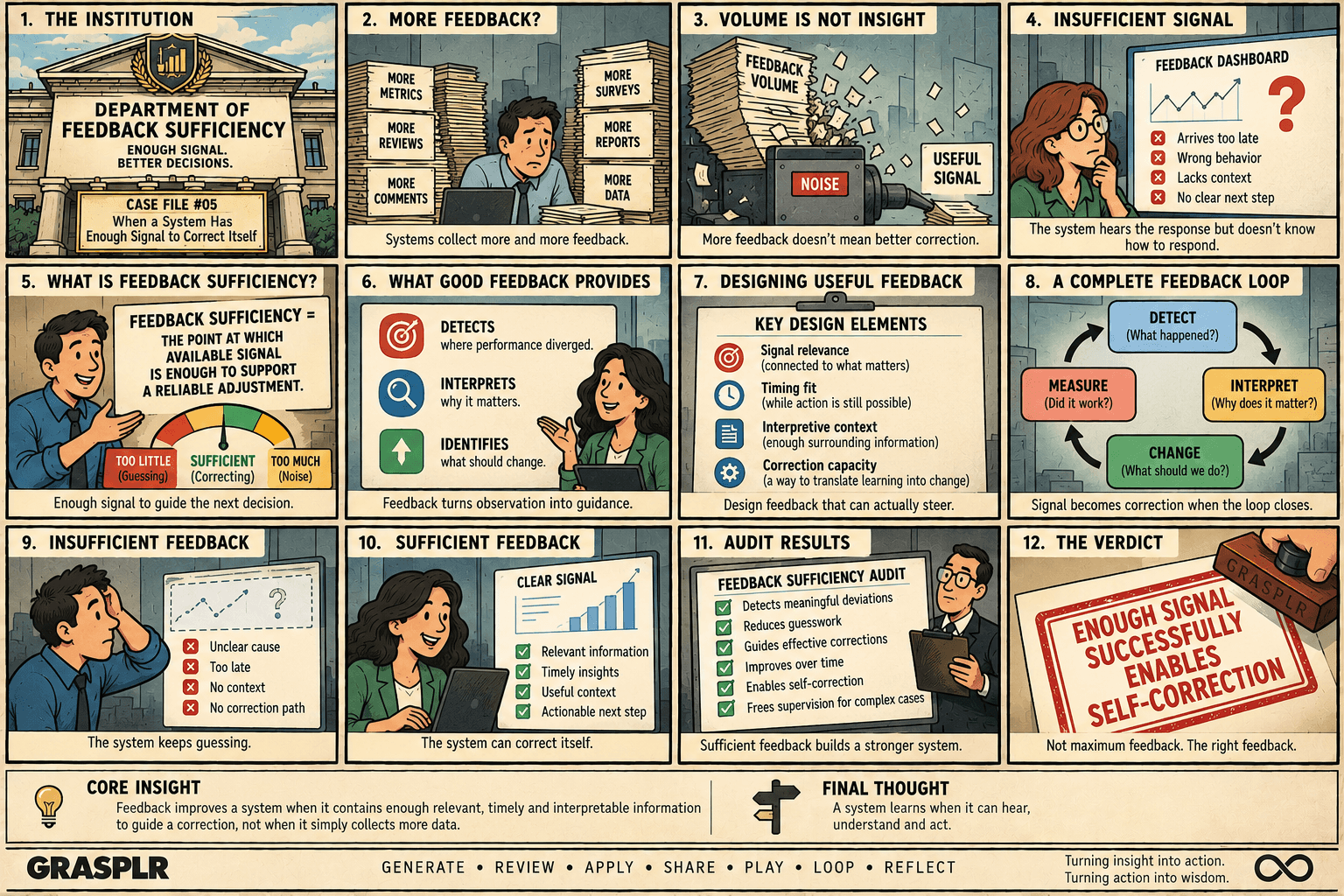
Too little signal and the system keeps guessing. Too much and useful information can disappear inside noise. Feedback Sufficiency is the point at which a system receives enough relevant, timely, and interpretable information to recognize deviation and guide a correction.
The goal isn’t maximum feedback. It’s enough signal to support the next decision.
More Feedback Doesn’t Mean Better Correction
Systems often respond to uncertainty by collecting more.
More metrics. More reviews. More comments. More surveys. More reporting layers.
But volume and usefulness are different things. A system can be surrounded by feedback and still lack the information required to understand what is going wrong.
Feedback becomes insufficient when it arrives too late, measures the wrong behavior, lacks necessary context, or identifies a problem without indicating where correction should occur.
The system can hear the response without knowing how to respond.
Feedback Sufficiency as a Correction Threshold
Feedback Sufficiency is the threshold at which available signal becomes sufficient to support a reliable adjustment.
Below that threshold, decisions depend heavily on assumptions. Once the threshold is reached, additional feedback may add detail without materially improving the correction.
Sufficient feedback answers more than “Did this work?” It helps the system detect where performance diverged, interpret why that divergence matters, and identify what should change in response.
That is what turns feedback from observation into guidance.
Designing Feedback That Can Actually Steer
Useful feedback must do more than describe an outcome. It needs to support the full correction loop: detect deviation, preserve enough context to interpret it, and connect what was learned to an available response.
Signal Relevance: Capture information directly connected to the behavior or outcome the system needs to improve.
Timing Fit: Return feedback while the system can still connect the signal to the decision that produced it.
Interpretive Context: Preserve enough surrounding information to distinguish meaningful patterns from isolated reactions.
Correction Capacity: Give the system a mechanism for translating what it learns into an actual change.
Without that final step, feedback remains information rather than correction.
Sufficient Feedback Enables Self-Correction
A system without feedback repeats itself. A system with poor feedback reacts without enough information. A system with sufficient feedback can learn from the difference between what it intended and what actually happened.
But signal alone does not make a system self-correcting. The loop closes only when the system can interpret that signal and change its behavior in response.
When Feedback Sufficiency is built into the loop, supervision can focus on cases where the available signal is genuinely ambiguous or incomplete. Mistakes become inputs to future decisions rather than isolated endpoints.
The strongest feedback loops don’t capture everything.
They capture enough to detect what changed, understand why it matters, and determine what should happen next.