
Interpret any idea, article, belief, observation, or experience through different systems lenses.
Each lens restructures the same input differently:
- some reveal operational systems
- some expose hidden pressures
- some translate complexity
and others alter perception itself.
The same input can produce radically different outputs depending on the selected frame.
Misconception Engine
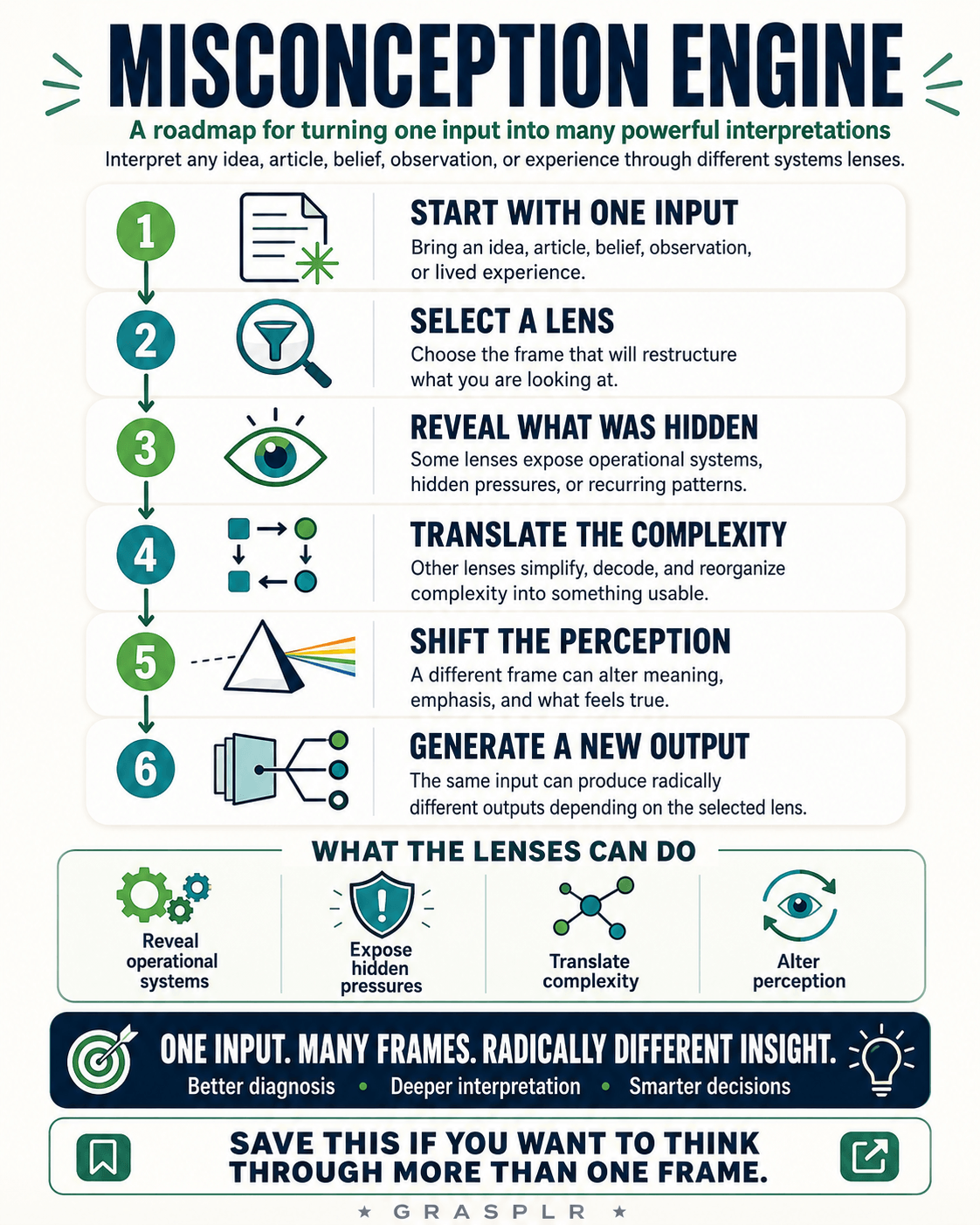
A structural interpretation system that reveals hidden mechanisms beneath beliefs, narratives, experiences, business claims, and observable events.
Rather than arguing against ideas directly, the Misconception Engine exposes the unseen architecture producing the outcome.
Different systems lenses reveal:
- hidden dependencies
- behavioral patterns
- structural tensions
- operational pressures
- perception distortions
- failure pathways
The same input can produce radically different interpretations depending on the selected frame.
The purpose is not merely to explain events.
The purpose is to reveal the hidden structures already shaping them.
Component Architecture List
[ARCHITECTURE] GRITS Lite – ME System Architecture
GRITS Lite serves as the overarching interpretive framework organizing all systems, lenses, modes, stacks, and analytical components inside the Misconception Engine. It acts as the master architecture governing how structural interpretation, hidden pressure analysis, symbolic trajectory mapping, and perception restructuring operate together as one unified system.
[CORE] Risk & Failure Analysis
This core examines how systems accumulate instability over time. It identifies pressure points, structural weaknesses, hidden dependencies, overload conditions, and collapse pathways likely to emerge if operational tensions continue unresolved.
[CORE] Systems & Operations
This core interprets systems as operational architectures composed of infrastructure, processes, dependencies, flows, constraints, and maintenance requirements. It focuses on how systems function structurally rather than how they appear on the surface.
[CORE] Psychology & Behavior
This core analyzes behavioral systems, subconscious reinforcement loops, emotional triggers, identity pressures, and hidden psychological mechanisms shaping decisions, reactions, and perceptions beneath conscious awareness.
[CORE] Marketing & Conversion
This core interprets persuasion, audience influence, trust formation, narrative framing, attention manipulation, and conversion mechanics as structured operational systems designed to guide behavior and shape perception.
[CORE] Explain in Systems Language
This core converts complex ideas, events, narratives, and experiences into structural systems terminology. It focuses on operational causality, hidden mechanisms, dependencies, flows, and pressure dynamics rather than emotional or surface-level explanation.
[ENGINE] The Physics Engine
The Physics Engine establishes the foundational interpretive laws governing how systems are analyzed throughout the framework. It determines the operational logic, causal assumptions, pressure behavior, and structural rules shaping all interpretation layers.
[ENGINE] Business Systems Misconception Engine
The Business Systems Misconception Engine exposes hidden operational pressures, structural dependencies, narrative distortions, and unseen mechanisms operating beneath business claims, organizational behavior, branding, persuasion, and market positioning.
[FILTER] The Analytical Emphasis Filter
The Analytical Emphasis Filter determines which hidden force or operational mechanism receives priority during interpretation. It acts as the dominant analytical bias shaping what pressures, patterns, and structural dynamics become most visible.
[LANG] Influence Language
Influence Language analyzes persuasion framing, behavioral activation patterns, emotional leverage systems, and linguistic structures designed to shape decisions, beliefs, and audience behavior.
[LANG] Orientation Language
Orientation Language focuses on directional framing and cognitive positioning. It analyzes how language guides perception, establishes interpretive pathways, and subtly controls the way information is mentally organized.
[LANG] Narrative Language
Narrative Language interprets stories, symbolic framing, sequencing, emotional arcs, and meaning construction systems that shape how people interpret events, identities, and experiences.
[LANG] Political Language
Political Language examines power framing, ideological positioning, authority narratives, group alignment systems, and rhetorical mechanisms used to shape collective belief and social influence.
[LANG] Media Language
Media Language analyzes attention shaping systems, information framing, emotional amplification mechanisms, symbolic reinforcement, and perception management operating within media environments.
[LANG] Psychological Language
Psychological Language interprets identity framing, emotional activation, subconscious trigger systems, internal narrative reinforcement, and linguistic mechanisms influencing human behavior and self-perception.
[LENS] The Unseen Prediction Engine
The Unseen Prediction Engine analyzes systems as generators of future structural consequences. It focuses on delayed pressures, adaptation pathways, collapse trajectories, compensatory systems, and future governance structures likely to emerge from present conditions.
[LENS] The Unseen Words Layer
The Unseen Words Layer interprets language as operational infrastructure shaping perception, emotion, identity, attention, and behavioral outcomes. It reveals the hidden linguistic architecture operating beneath narratives and communication systems.
[LENS] The Unseen Pentagram Layer
The Unseen Pentagram Layer interprets systems as interacting force centers competing for stability, dominance, preservation, adaptation, and survival. It focuses on center imbalance, pressure distribution, compensatory behavior, and structural force dynamics.
[LENS] The Unseen Tarot Layer
The Unseen Tarot Layer interprets systems as symbolic trajectory archetypes moving through cycles of emergence, destabilization, collapse, adaptation, and transformation. It uses structural archetypes and symbolic sequencing to reveal evolving system trajectories.
[LAYER] The Environment Physics Modifier
The Environment Physics Modifier alters how systems behave by changing the environmental logic surrounding interpretation. It controls the operational conditions, constraints, pressures, and external forces shaping system behavior.
[MODE] Narrative Structure Interpreter
This mode analyzes narratives, conversations, social posts, and commentary through structural pattern recognition. It identifies narrative sequencing, hidden framing, symbolic positioning, and behavioral influence structures.
[MODE] Structural Narrative
Structural Narrative transforms systems analysis into immersive storytelling structures. It presents operational pressures, hidden mechanisms, and system dynamics through cinematic narrative interpretation.
[MODE] Systems Translator
Systems Translator converts complex concepts, emotional ideas, abstract theories, and confusing situations into structured operational systems terminology for clearer analysis and interpretation.
[MODE] Render Structure
Render Structure generates visual systems blueprints and operational architecture maps designed to reveal hidden flows, dependencies, pressure points, structural relationships, and system interactions visually.
[MODE] The Unseen Frame
The Unseen Frame exposes hidden structures operating beneath accepted narratives and observable reality. It restructures perception by revealing concealed pressures, dependencies, symbolic framing systems, and operational architecture.
[STACK] System Failure Analysis
This stacked system combines collapse analysis, instability detection, dependency mapping, overload analysis, and structural failure interpretation to reveal how systems deteriorate under unresolved pressure.
[STACK] Media Reality Breakdown
Media Reality Breakdown combines media systems analysis, perception shaping, narrative framing, symbolic reinforcement, and structural influence mapping to expose how media environments shape public interpretation.
[STACK] Persuasion Deconstruction
Persuasion Deconstruction combines narrative analysis, influence architecture, emotional activation systems, and behavioral framing to reveal the hidden mechanics operating beneath persuasive communication.
[STACK] Psychological Breakdown
Psychological Breakdown combines subconscious pressure analysis, emotional systems interpretation, behavioral reinforcement loops, identity structures, and hidden cognitive dynamics to expose underlying psychological architecture.
[STRUCTURE] The Rendering Engine
The Rendering Engine controls how interpretation outputs are formatted, sequenced, visualized, and presented. It shapes the structural presentation layer through which analysis becomes readable, symbolic, visual, or narrative.
[INPUT] The Object Being Analyzed
The Object Being Analyzed is the target system entering the interpretive framework. It may include beliefs, narratives, organizations, identities, institutions, behaviors, events, social systems, business claims, psychological states, or observable phenomena.