Repetition Architecture – Why Systems Keep Producing the Same Outcomes

The same conflict, delay, habit, mistake, reaction, or result can keep returning even after everyone promises to change.
How Systems Produce Repetition means looking beneath commitment and asking what loop is still active.
Outcomes repeat because systems remember through incentives, environments, emotional defaults, structural reinforcement, and the paths people have learned to follow.
Promises Cannot Outperform Structure Forever
Most people treat repeated outcomes as a motivation problem.
If the same issue keeps happening, someone must not care enough, try hard enough, or understand clearly enough.
So the system responds with reminders, renewed commitments, stronger language, and fresh urgency.
But promises fade quickly when the surrounding structure stays the same.
A team may promise better communication while the workflow still rewards speed over clarity. A person may commit to a new habit while their environment keeps cueing the old one. An organization may ask for innovation while punishing the risk that innovation requires.
The intention may be real.
But the system is still arranged to reproduce the familiar result.
Repetition is often the structure continuing to speak after the promise has ended.
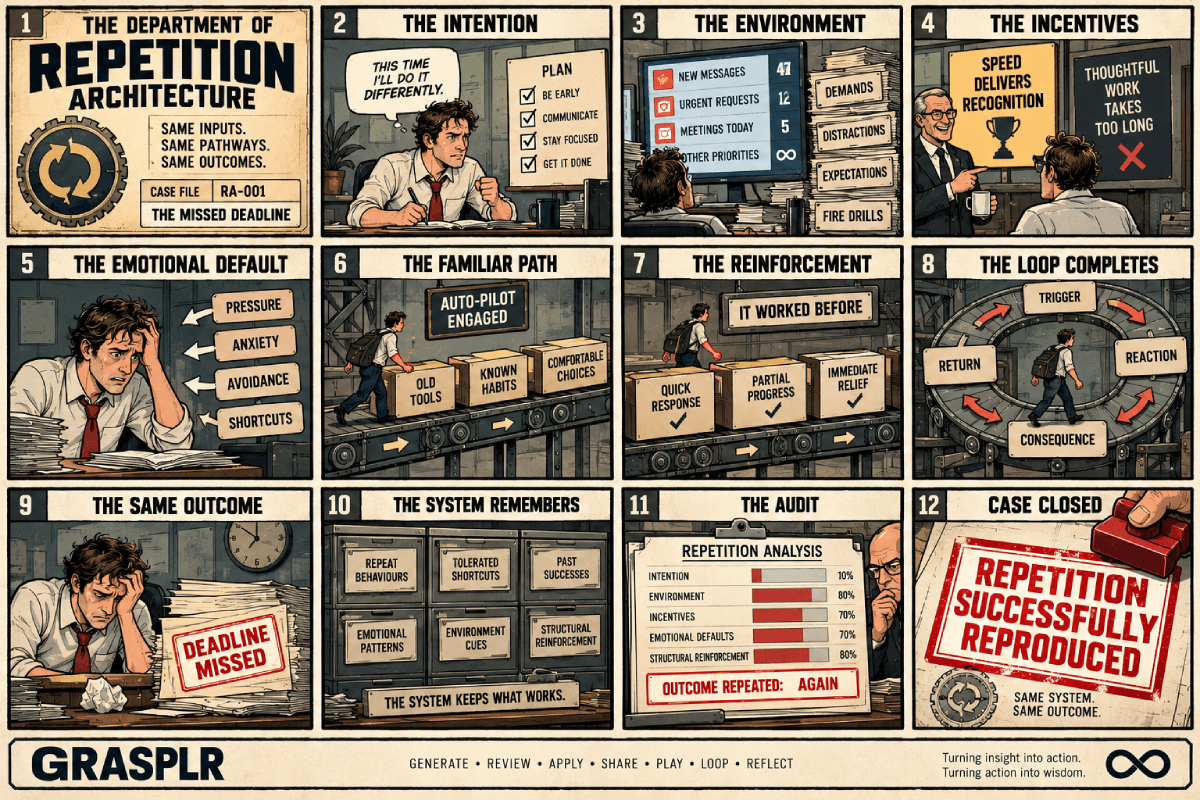
Repetition Architecture as System Memory
Repetition Architecture is the set of loops and reinforcements that cause a system to produce the same outcome again and again.
It includes visible structures like rules, workflows, tools, and incentives. It also includes less visible forces like emotional memory, identity patterns, defaults, avoidance, and shared assumptions.
Systems remember through repeated pathways.
What gets rewarded becomes easier to repeat. What gets tolerated becomes easier to preserve. What feels safe becomes easier to return to. What requires less energy becomes the default under pressure.
Think of repetition as system memory in motion.
The system remembers what has worked before, what has been rewarded, what has been tolerated, what has felt safe, and what has required the least effort.
Over time, those remembered pathways become easier to travel than new ones.
People may want change, but under pressure they often return to the route the system has practiced most.
This shifts the question from “Why does this keep happening?”
You begin asking, “What is still reinforcing this pattern?”
Reading the Forces That Recreate Outcomes
To understand repetition, follow the pattern through the system.
Look for what keeps making the old outcome easier than the new one.
- Loop patterns: Identify the cycle that repeats: trigger, reaction, consequence, return. Repetition usually survives because each part of the loop feeds the next.
- Incentive signals: Examine what behavior earns relief, approval, speed, status, safety, or resources. Systems repeat what they reward, even quietly.
- Memory traces: Notice where past experiences shape present reactions. Teams, relationships, and individuals carry memory through fear, caution, pride, mistrust, or expectation.
- Environment cues: Study what the setting makes automatic. Tools, spaces, schedules, notifications, and social cues can pull behavior back into familiar paths.
- Emotional defaults: Watch what people do when pressure rises. Defensiveness, avoidance, overcontrol, compliance, withdrawal, or urgency may be the system’s learned emotional shortcut.
- Structural reinforcement: Ask what rules, roles, processes, metrics, or dependencies keep the repeated outcome in place. The pattern will continue if the architecture still supports it.
Once these forces become visible, repetition stops looking mysterious.
The system is not merely failing to change.
It is successfully reproducing what it has been built to repeat.
Change Requires Interrupting the Pattern, Not Just Naming It
Strong systems do not break repetition through promises alone.
They change the loops that make repetition likely.
How Systems Produce Repetition teaches that recurring outcomes are maintained by reinforcement: incentives, memory, environment, emotion, and structure working together to keep the familiar path open.
When you read repetition systemically, you stop blaming the return of the pattern as simple weakness.
You begin redesigning the conditions that keep inviting it back.
Change the cue, shift the reward, alter the pathway, name the emotional default, adjust the structure, and the system begins to learn a different route.
A repeated outcome is not only something going wrong.
It is a system showing you what it knows how to produce.