
In many organizations, friction between teams feels unavoidable.
Product wants to move quickly. Operations wants stability. Finance emphasizes cost discipline. Customer support pushes for reliability. Each team sees the system from a different angle, and coordination often becomes a negotiation.
Meetings multiply. Decisions take longer. Teams feel like they are constantly resolving misunderstandings.
This friction is often treated as a communication problem.
But frequently, the deeper issue is simpler: the teams are not working from the same direction.
Systems Layer
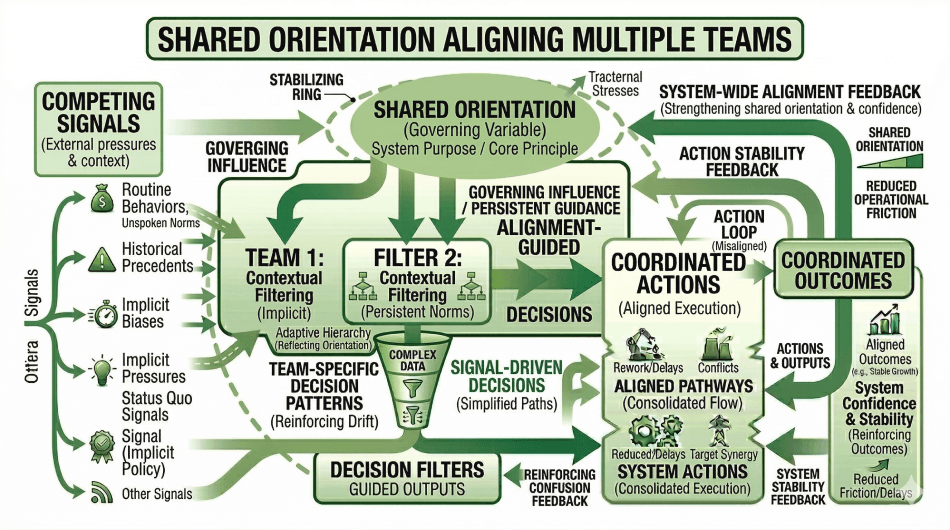
In Systems Language, alignment emerges when multiple subsystems reference the same governing variable.
Each team within an organization operates as a subsystem. It receives signals, interprets priorities, and generates actions within its own domain.

Within the five-pillar framework, Orientation reduces structural friction by giving every subsystem the same reference point for decision-making.