
You try to complete a simple task — submit a report, configure a setting, or follow a procedure. The work itself isn’t particularly difficult. But the process around it feels frustrating.
Instructions are scattered across documents. The interface uses unfamiliar labels. Important information is buried in long messages. You switch between multiple tools just to finish one step.
The task should be straightforward, yet it takes far more effort than expected.
The problem isn’t the task. It’s the system around it.
Systems Layer
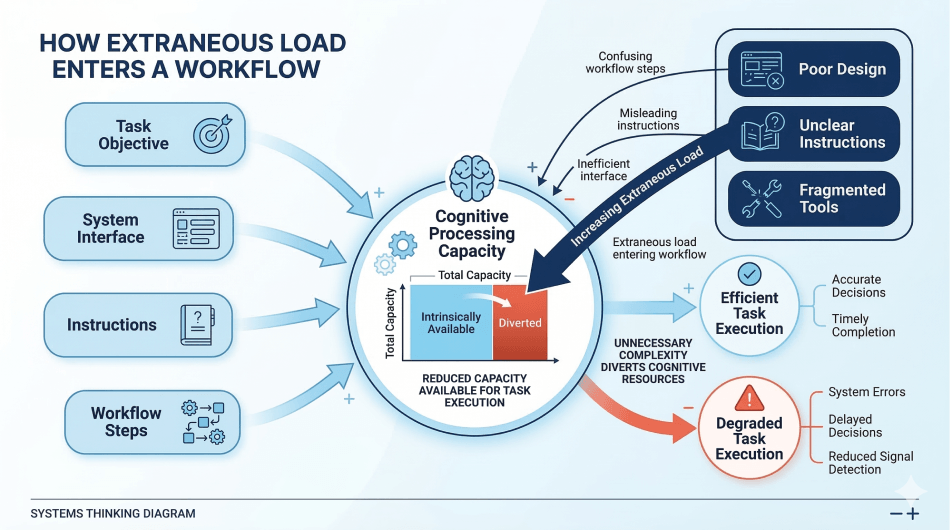
Extraneous load is the cognitive demand created by how work is presented, structured, or delivered, rather than by the work itself.
In systems terms, extraneous load emerges when the environment introduces unnecessary processing requirements that do not contribute to solving the core problem.

When extraneous load falls, clarity and performance rise almost immediately.