

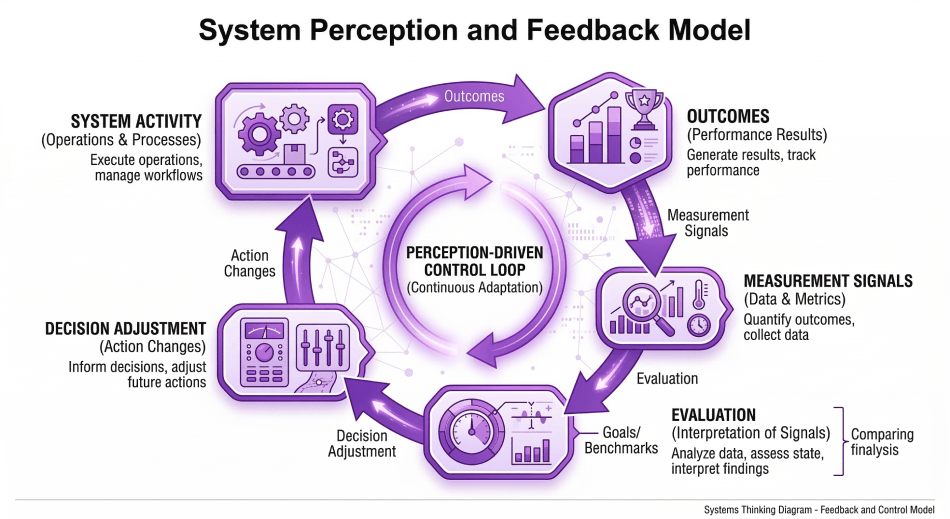
The System Perception and Feedback Model illustrates how systems observe their own performance and adjust behavior over time. Unlike linear systems that simply produce outcomes, adaptive systems monitor results, interpret signals, and use that information to guide future actions.
This diagram shows a continuous control loop in which system activity produces outcomes, outcomes generate measurement signals, and those signals are evaluated to inform future decisions. Through this cycle, the system learns from experience and gradually improves how it operates.
At the center of the model is the perception-driven control loop, representing the ongoing process through which systems observe, evaluate, and adapt.
System Activity
The cycle begins with system activity. This includes the operational processes and actions through which the system performs its work.
Examples of system activity may include executing workflows, delivering services, manufacturing products, or processing information. These activities represent the operational behavior of the system. 
When systems can clearly perceive their own outcomes, they gain the ability to adjust behavior continuously.
Over time, this perception-driven learning process becomes one of the most powerful mechanisms for sustained system improvement.
