
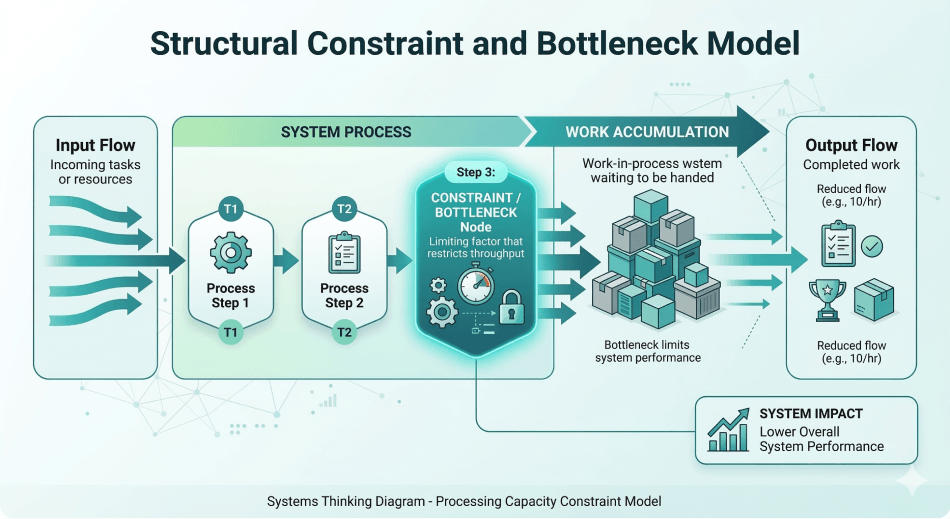
The Structural Constraint and Bottleneck Model illustrates how the performance of an entire system is often determined by a single limiting component. In many operational systems, work moves through a sequence of steps, forming a processing pipeline. Although multiple stages may exist, the throughput of the entire system is ultimately limited by the slowest or most constrained stage.
This diagram shows how incoming work flows through a series of process steps before encountering a structural constraint. When the capacity of this constraint is lower than the rate of incoming work, tasks begin to accumulate, creating queues and reducing overall system performance.
Understanding where constraints occur is essential for improving system efficiency because optimizing non-constrained parts of a system rarely increases total output.
Input Flow
The system begins with an input flow representing incoming tasks, materials, or resources entering the system.
In operational environments this may include customer requests, production materials, project assignments, or incoming data. Input flow determines how much work the system must process over time. 
Once the constraint is expanded or removed, system throughput immediately increases because the limiting factor has changed.
By focusing improvement efforts on structural constraints rather than individual activity levels, systems designers can achieve far greater gains in overall performance.