

Many teams believe delegation should happen naturally.
As work increases, tasks are simply handed to someone else. Another team member takes responsibility, or an external provider is asked to help. The expectation is that work will redistribute automatically.
But in practice, delegation often feels difficult.
Tasks return with questions. Outputs require extensive corrections. The original role ends up supervising every step, making the process feel more exhausting than doing the work alone.
The challenge is rarely the willingness to delegate—it is the system’s ability to support delegation.
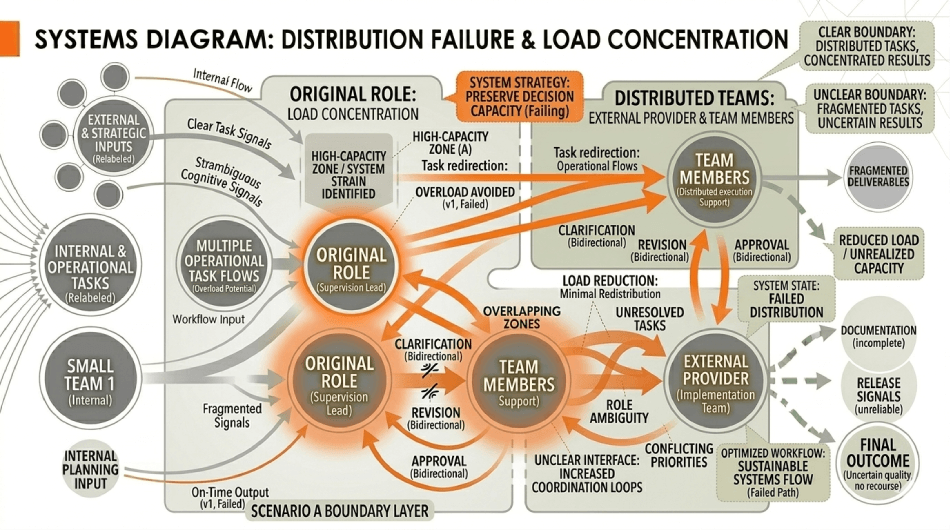
Systems Layer
Delegation depends on structural readiness.
For work to move from one node to another, the system must provide a clear processing interface between those nodes.

When systems are intentionally structured with clear interfaces and repeatable processes, work can move across nodes without bringing the original load back with it.
