

Autonomy inside organizations is often discussed as a cultural attribute: trust, empowerment, freedom. These terms point in the right direction, but they obscure a more concrete mechanism. Autonomy emerges when decision authority is placed close to the information required to make those decisions.
A simple observation helps ground this. In any coordinated activity, there are choices that affect the whole and choices that affect only a part. When all choices are routed through a central point, coordination slows and local context is lost. When every choice is made locally without constraint, coherence dissolves. Functional autonomy sits between these extremes.
Outsourcing reshapes where this balance lands.
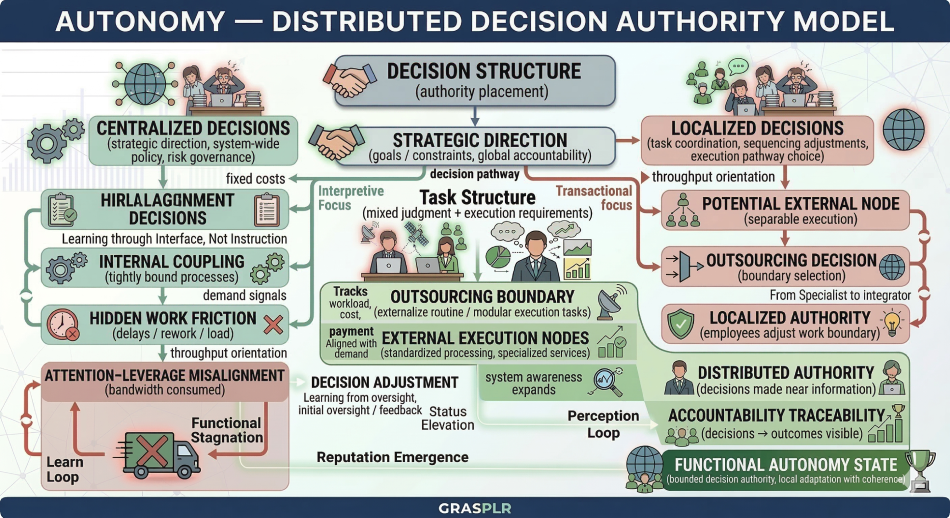
Decision Space, Not Independence
Autonomy does not mean independence from the system. It means having a defined decision space within it.

The system becomes both more distributed and more coherent at the same time.
