

In many organizations, outsourcing is discussed in financial terms: cost reduction, variable capacity, efficiency gains. Yet when you look closely at how outsourcing actually operates inside a company, a different pattern becomes visible. The most consequential effects are not financial. They are structural.
Consider a familiar scene: a team where individuals are allowed to decide which tasks to keep close and which to hand off. Some work remains tightly coupled to their judgment and context. Other work is deliberately pushed outward to specialists, tools, or temporary collaborators. What changes first is not output volume, but attention.
Attention is a scarce resource inside any system. Where it is directed determines what can be noticed, improved, or corrected. Outsourcing alters the distribution of attention by changing who is responsible for what, and how tightly different activities are bound together.
In this sense, outsourcing is less a procurement tactic and more a boundary-setting mechanism.
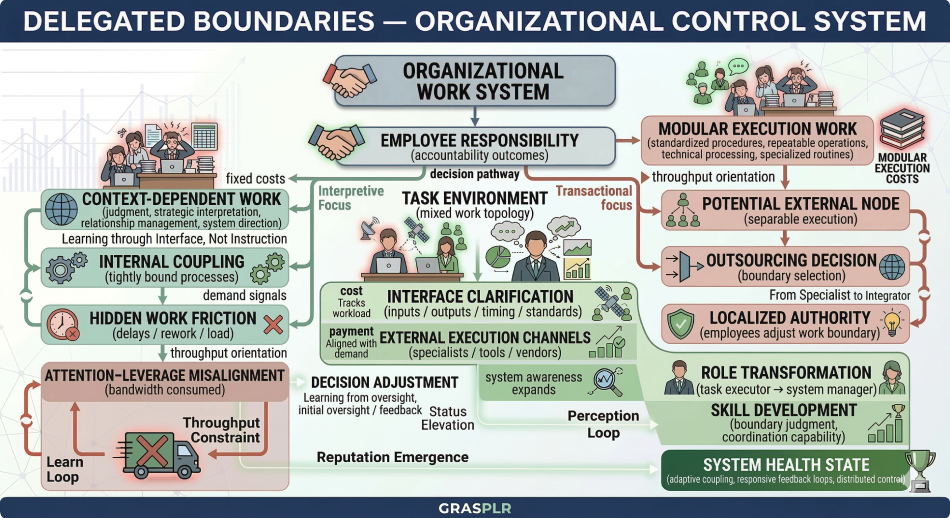
What Becomes Visible When Tasks Move
When tasks are retained internally, their friction is often absorbed silently. Delays, rework, and inefficiencies blend into daily routines. Once a task is outsourced, its interfaces must be named. Inputs, outputs, timing, and quality expectations are forced into visibility.

The outcome is not a motivational uplift, but a structural one. Engagement emerges as a side effect of coherence, not as a target to be engineered.
