
Employee empowerment is often framed as motivation or trust. But in operational terms, empowerment is less about sentiment and more about who controls boundaries: what work stays inside a role, what moves outside, and who decides.
A visible pattern appears in small and mid-sized organizations under growth pressure. Employees are capable and committed, yet much of their time is spent managing constraints rather than outcomes. They wait for resources, stretch across unfamiliar tasks, or compensate for missing capacity. Authority exists, but it is thinly spread across too many obligations.
Outsourcing changes this by relocating certain constraints beyond the individual role.
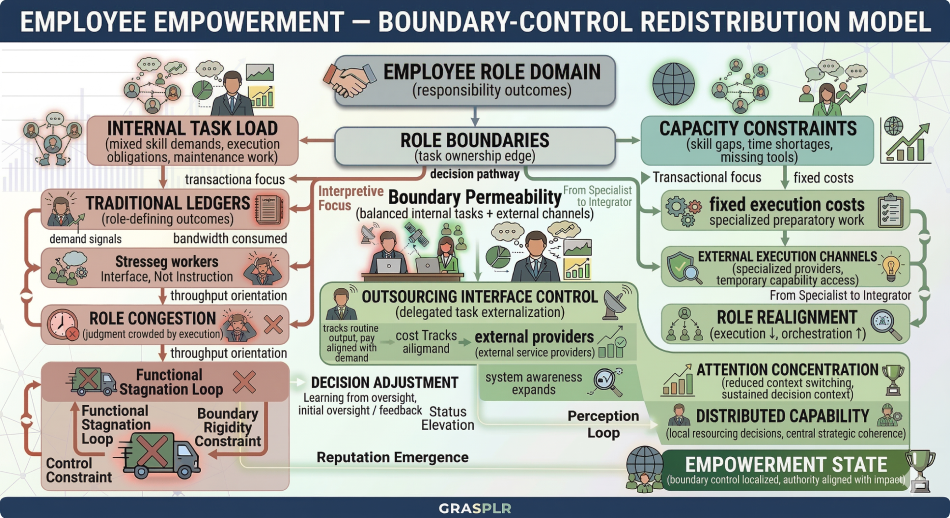
Empowerment as Control Over Interfaces
When employees are allowed to outsource specific tasks, they gain control over interfaces rather than over people. This distinction matters.
Instead of requesting additional internal support or escalating capacity issues upward, employees can directly shape how work enters and exits their domain. They decide what to delegate, how to specify it, and how to integrate the result. Their influence shifts from execution to orchestration.
Employees feel empowered when they can act on what they know without constantly compensating for missing resources. Outsourcing provides one way to close that gap.
The result is not a dramatic transformation, but a steadier system where employees can shape outcomes rather than work around constraints.