
Sales outcomes are often discussed as the result of effort, persuasion, or market timing. Yet when organizations experience sudden increases—or plateaus—in sales, the underlying cause is frequently structural rather than behavioral.
A useful place to start is with capacity. Any organization operates with a finite amount of cognitive, technical, and temporal capacity. How that capacity is allocated determines what kinds of results are even possible. When sales stall, it is often not because people are insufficiently motivated, but because attention and skill are consumed by work that does not directly support growth.
Outsourcing alters this allocation.
Consider a small technology firm facing rising demand. Orders increase, customer inquiries multiply, and product expectations escalate. Internally, the same limited team is responsible for maintaining infrastructure, responding to customers, fixing defects, and imagining what comes next. Even if everyone works harder, the system becomes congested. Growth pressure accumulates at the same nodes.
Outsourcing does not remove demand. It redistributes load.
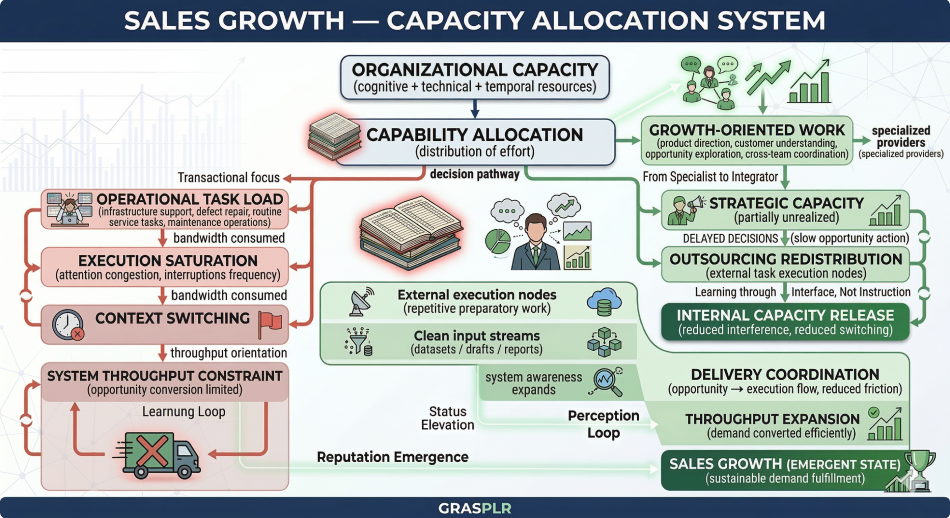
Capacity as a Limiting Structure
In systems terms, sales growth is constrained by throughput, not ambition. Throughput depends on how quickly an organization can move from opportunity to delivery without degradation in quality.

The important distinction is that outsourcing does not cause sales. It changes the system in which sales occur.
When growth follows, it is because the organization has become better at converting demand into delivery without exhausting itself in the process.