

Complexity becomes useful only when it can be translated.
Pressure, confusion, scattered ideas, unclear signals, and competing demands often arrive as noise before they become action.
The Translation Engine is the personal or business system that converts that noise into structure: categories, questions, diagrams, prompts, workflows, articles, decisions, and next steps.
It helps you stop carrying complexity as overwhelm and start shaping it into something you can use.
Untranslated Complexity Becomes Cognitive Weight
Most people do not lack information.
They lack a way to process it.
A business owner may feel pressure from customers, content, cash flow, delivery, and decisions all at once. A creator may have too many ideas but no clear structure for turning them into useful work. A team may sense that something is wrong, but cannot yet name whether the issue is capacity, timing, alignment, or priority.
When complexity stays untranslated, it becomes weight.
Everything feels urgent. Every signal competes for attention. Every decision feels connected to every other decision.
Without translation, people either freeze, react, or oversimplify.
They do not move from clarity.
They move from pressure.
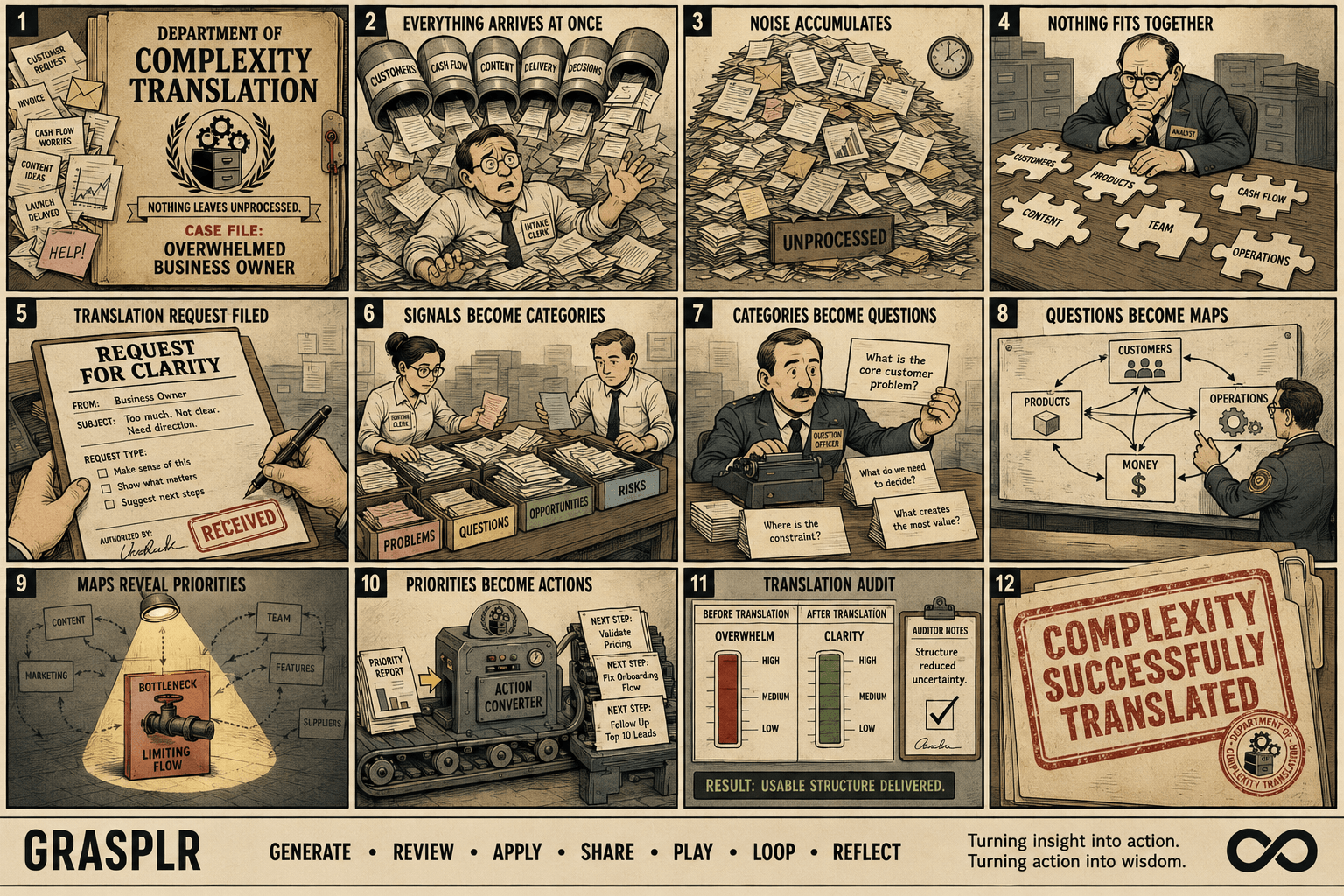
Translation Engine as Structural Conversion
A Translation Engine is the repeatable process you use to convert complexity into usable forms.
It takes what feels vague, tangled, or overwhelming and turns it into categories that thought and action can move through.
Translation reduces overwhelm because it gives pressure somewhere to go. It does not flatten complexity. It sorts it, names it, and gives it a form that can be examined, shared, and acted on.
Think of it as a meaning machine.
Unclear pressure goes in; structured output comes out.
A messy concern becomes a diagnostic question. A repeated customer issue becomes a content theme. A scattered strategy becomes a workflow. A confusing pattern becomes a diagram. A vague intuition becomes a decision prompt.
This shifts the question from “How do I handle all of this?”
You begin asking, “What form does this complexity need to become?”
Converting Pressure Into Usable Forms
To build a Translation Engine, create pathways that help complexity change shape.
Each output gives the system a different kind of clarity.
- Categories: Sort unclear pressure into named types: capacity, timing, trust, alignment, constraint, feedback, or decision. Naming reduces the blur.
- Questions: Turn confusion into inquiry. A good question slows reaction and points attention toward structure.
- Diagrams: Map relationships, loops, pathways, and consequences. Diagrams make invisible connections easier to see.
- Prompts: Create reusable thinking tools that help you process recurring complexity. Prompts turn uncertainty into a repeatable practice.
- Workflows: Convert insight into sequence. A workflow shows what happens first, next, and after that, so action stops scattering.
- Articles: Transform patterns into teachable frameworks. Writing helps complexity become language others can understand and use.
- Decisions: Use translated structure to choose more clearly. Decisions improve when pressure has been sorted, named, and connected.
When these forms are available, complexity no longer has to remain internal.
It can move outward into structures that hold it.
Clarity Is Built by Translation
Strong thinkers, creators, and businesses do not avoid complexity.
They build engines that translate it.
The Translation Engine shows that unclear pressure can become a category, a question, a diagram, a prompt, a workflow, an article, or a decision when there is a structure ready to receive it.
When you translate complexity, you reduce overwhelm without reducing depth.
You give thought a path, action a sequence, and pressure a useful shape.
The goal is not to make everything simple.
The goal is to make complexity legible enough to work with.
A system becomes more intelligent when it can translate what it feels into what it can use.
