
Changing a system is never neutral.
Every intervention touches people, relationships, power, access, trust, and future consequences.
The Ethics of Systems Intervention means recognizing that when you redesign a process, shift an incentive, alter a pathway, or introduce a new rule, you are not only improving performance.
You are changing the conditions people must live, work, decide, and relate inside.
Systems Literacy becomes ethical when it asks not only, “Will this work?”
It also asks, “What will this do to the whole?”
Change Can Help One Part While Hurting Another
Most interventions begin with a good intention.
Make the workflow faster. Improve accountability. Increase conversion. Reduce confusion. Raise quality.
But systems do not receive change in one place only.
A decision that creates efficiency for leadership may create hidden labor for the team. A new metric may improve visibility while distorting behavior. A tighter process may reduce errors while reducing trust. A stronger growth push may increase revenue while exhausting capacity.
When intervention is judged only by its intended outcome, its wider effects can stay invisible.
The system may look improved at the center while pressure, exclusion, confusion, or resentment gathers at the edges.
Ethical change requires reading beyond the visible win to see who absorbs the cost.
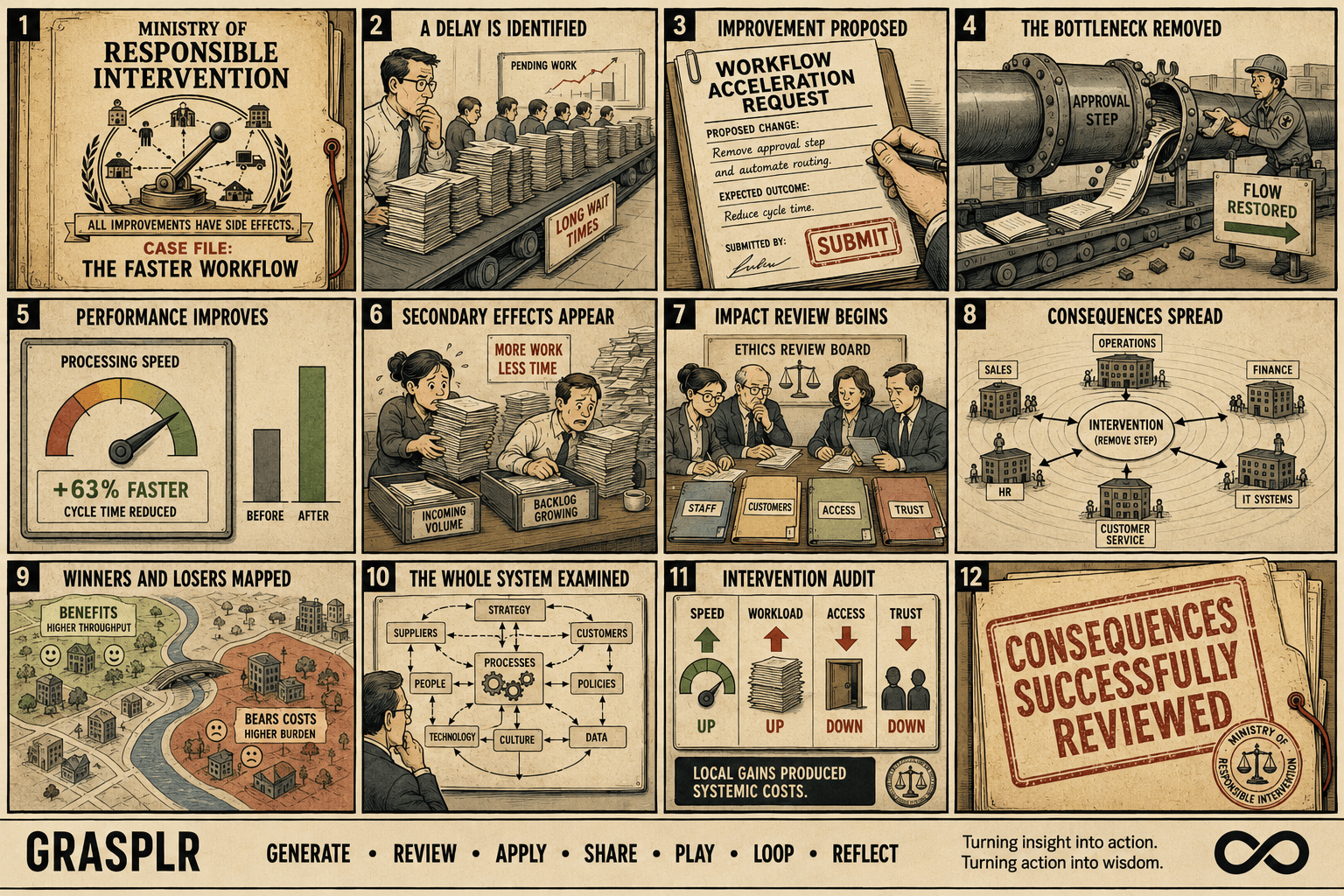 The Ministry of Responsible Intervention investigates a workflow improvement that initially appears successful. As consequences spread through the wider system, hidden trade-offs emerge. The comic reveals that systems literacy becomes ethical when interventions are evaluated not only by immediate results, but by how they reshape conditions for everyone affected.
Intervention Ethics as Responsible System Design
Intervention Ethics is the discipline of changing systems with awareness of impact.
It treats every adjustment as a moral act because every adjustment redistributes attention, authority, risk, opportunity, and consequence.
That redistribution is what gives intervention ethical weight.
A new rule changes what behavior is safe. A new metric changes what becomes visible. A new process changes who carries effort. A new pathway changes who can participate.
Think of it as care before control.
A systems-literate intervention does not ask only whether a change is efficient.
It asks whether the change is fair, legible, proportionate, and humane.
Who gains power? Who loses access? Who must adapt? Who gets heard? Who carries the burden if the design fails? What future behavior will this intervention make more likely?
This shifts the question from “How do we change the system?”
You begin asking, “How do we change it without causing avoidable harm?”
Reading the Ethical Weight of Intervention
Before changing a system, study where the effects will travel.
Ethical intervention requires seeing the human and structural consequences together.
- People effects: Identify who will experience the change directly and indirectly. A system may improve on paper while becoming harder for people to inhabit.
- Relationship effects: Watch how the intervention changes trust, cooperation, dependency, conflict, or belonging. Systems are held together by relationships, not just processes.
- Power effects: Ask who gains decision-making authority, visibility, control, or advantage. Every intervention rearranges power, even when it claims to be technical.
- Access effects: Notice whether the change makes participation easier for some and harder for others. Access is often shaped by timing, tools, language, knowledge, and capacity.
- Trust effects: Consider what the intervention signals. A change can be operationally useful but still damage trust if it feels hidden, punitive, rushed, or extractive.
- Future effects: Trace what the system will learn to repeat because of the change. Interventions become instructions for future behavior.
When these effects are visible, intervention becomes more accountable.
You can adjust the design before hidden costs become normalized.
Responsible Change Reads the Whole System
Systems Literacy is practical because it helps change work better.
It is ethical because it helps change do less harm.
The Ethics of Systems Intervention teaches that every redesign carries consequences across people, relationships, power, access, trust, and the future.
When you intervene with literacy, you become slower in the right places and stronger in the places that matter.
You listen before altering. You map consequences before imposing structure. You notice who carries the cost. You build feedback channels so the system can speak after the change begins.
A system is not just something to improve.
It is something people live inside.
To change it well, you must treat intervention as responsibility, not just strategy.