
The Hidden System Behind Every Incomplete Belief
Most misconceptions don’t survive because people are careless—they survive because systems keep producing them. A belief, assumption, or business narrative often looks true from the surface because it explains the visible outcome.
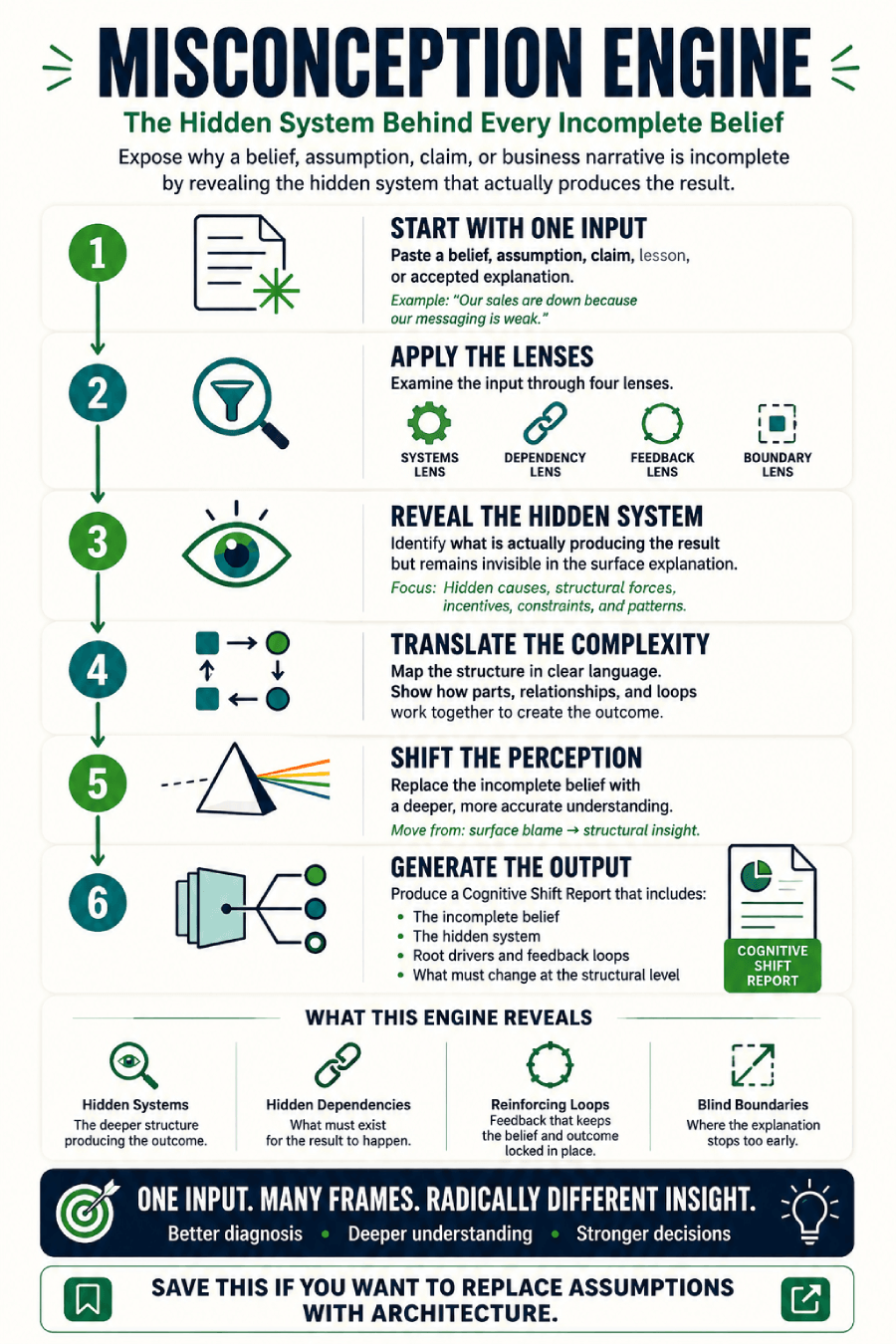
But beneath that outcome is a hidden engine: dependencies, incentives, feedback loops, and boundaries that shape what people notice, repeat, and accept. Misconception Engines expose that machinery, turning shallow explanations into structural understanding.
Incomplete Beliefs Feel Complete Until the System Appears
The problem with most accepted explanations is that they are usually not wrong enough to reject. They contain a piece of truth, which makes them feel useful. A struggling campaign gets blamed on weak messaging. A stalled team gets blamed on poor execution. A failed launch gets blamed on timing. Each explanation may be partially accurate—but partial accuracy can become a trap when it hides the deeper structure producing the result.
Misconceptions form when people mistake symptoms for causes. They focus on the visible event instead of the system that keeps recreating it. The belief becomes a shortcut, and the shortcut becomes the story everyone repeats.
Misconception Engines Reveal What Actually Produces the Result
A Misconception Engine is the hidden structure that generates and sustains an incomplete belief. It shows why a claim seems true, what it leaves out, and which forces are quietly shaping the outcome. Instead of asking, “Is this belief right or wrong?” it asks, “What system makes this belief feel true?”
That shift changes the analysis. A weak result may not come from weak effort, but from mismatched dependencies. Slow growth may not come from lack of demand, but from a feedback loop that prevents learning. Internal resistance may not come from stubborn people, but from structural inertia built into the process. Once the engine is visible, the misconception loses its grip.
Using the Misconception Engine to Create Cognitive Shift
Start with the accepted belief. Then pressure-test it through four lenses:
Systems Lens: What larger structure is producing the visible outcome?
Dependency Lens: What hidden inputs, constraints, or prerequisites does the explanation ignore?
Feedback Lens: What loops are reinforcing the current belief or result?
Boundary Lens: Where does the explanation stop too early?
This turns a simple claim into a Cognitive Shift Report: a clearer account of what is really happening, why the surface explanation feels convincing, and what needs to change at the structural level.
Replace Assumption With Architecture
The strongest insights don’t just correct a misconception—they reveal the engine behind it. When you expose the hidden system producing a belief, you move people from opinion to understanding. Misconception Engines help audiences see that outcomes are rarely caused by one obvious factor. They are produced by architecture. Once that architecture is visible, the conversation changes from “what do we believe?” to “what is the system making inevitable?”