
Revealing the Hidden Structures Beneath Everyday Reality
Most things appear simpler than they are. A successful company looks like good leadership. A thriving community looks like strong culture. A document looks like information. A process looks like a sequence of steps.
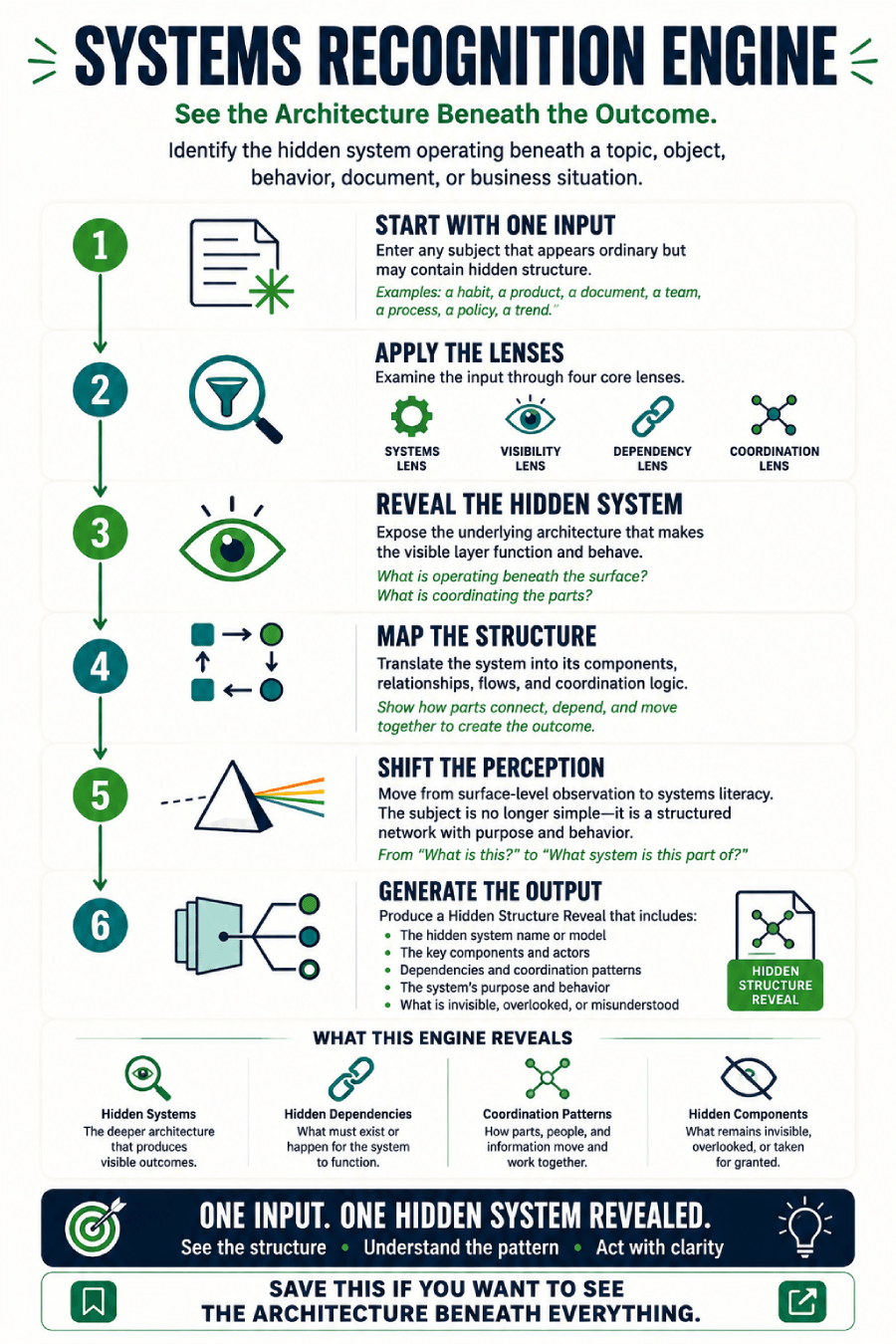
But beneath every visible outcome sits an invisible structure coordinating dependencies, directing flows, and shaping behavior. Systems Recognition Engines help uncover that hidden architecture, transforming ordinary observations into systems literacy.
The Most Important Systems Are Often Invisible
People naturally focus on what they can see. They notice actions, events, decisions, and outcomes. What they rarely notice are the structures that make those outcomes predictable.
When a business consistently outperforms competitors, observers often credit talent. When a team repeatedly misses deadlines, they blame execution. When a policy succeeds or fails, they focus on individual decisions. Yet these explanations usually describe visible symptoms rather than the system producing them.
The hidden structure remains unseen because it operates continuously in the background. Like electrical wiring behind a wall, its effects are obvious while its existence remains largely unnoticed.
Systems Recognition Engines Make Invisible Architecture Visible
A Systems Recognition Engine is a framework for identifying the underlying system operating beneath a topic, object, behavior, document, or business situation. Rather than asking what something is, it asks what structure is making it function.
This changes the nature of analysis entirely.
A document stops being a collection of words and becomes a coordination mechanism. A company stops being a group of employees and becomes a dependency network. A customer journey stops being a sequence of interactions and becomes a routing system for attention, trust, and action.
The visible layer remains important—but it is no longer the whole story. The hidden architecture becomes the primary object of investigation.
Using Systems Recognition to Reveal Hidden Structure
Begin with something that appears ordinary. Then examine it through four structural lenses:
- Systems Lens: What larger system is operating beneath the visible surface?
- Visibility Lens: Which critical components influence outcomes but remain difficult to observe directly?
- Dependency Lens: What inputs, relationships, or resources must exist for this system to function?
- Coordination Lens: How are activities, information, decisions, or resources synchronized across the structure?
As these questions accumulate, a Hidden Structure Reveal begins to emerge. What initially appeared to be a simple object, process, or outcome transforms into an interconnected system of relationships, constraints, and flows.
The goal is not merely to understand the parts. It is to understand how the parts coordinate to create behavior.
Systems Literacy Begins With Recognition
Most people try to solve problems at the level where they appear. Systems thinkers learn to look one layer deeper. They recognize that visible outcomes are often expressions of invisible structures.
Systems Recognition Engines develop this habit of seeing architecture where others see events. They train the mind to look beyond individual actions and uncover the dependencies, coordination patterns, and hidden mechanisms shaping results.
Once you can recognize the system beneath the surface, ordinary things stop looking ordinary. Every document becomes a coordination device. Every behavior becomes a signal. Every outcome becomes evidence of a deeper structure at work. And that is where genuine understanding begins.