
Investigating the Invisible Institutions Running Everyday Life
Most systems are too familiar to be noticed. People see the outcome, follow the procedure, accept the rule, and move on. Rarely do they stop to ask who designed the mechanism, what incentives it serves, or why it keeps reproducing the same result.
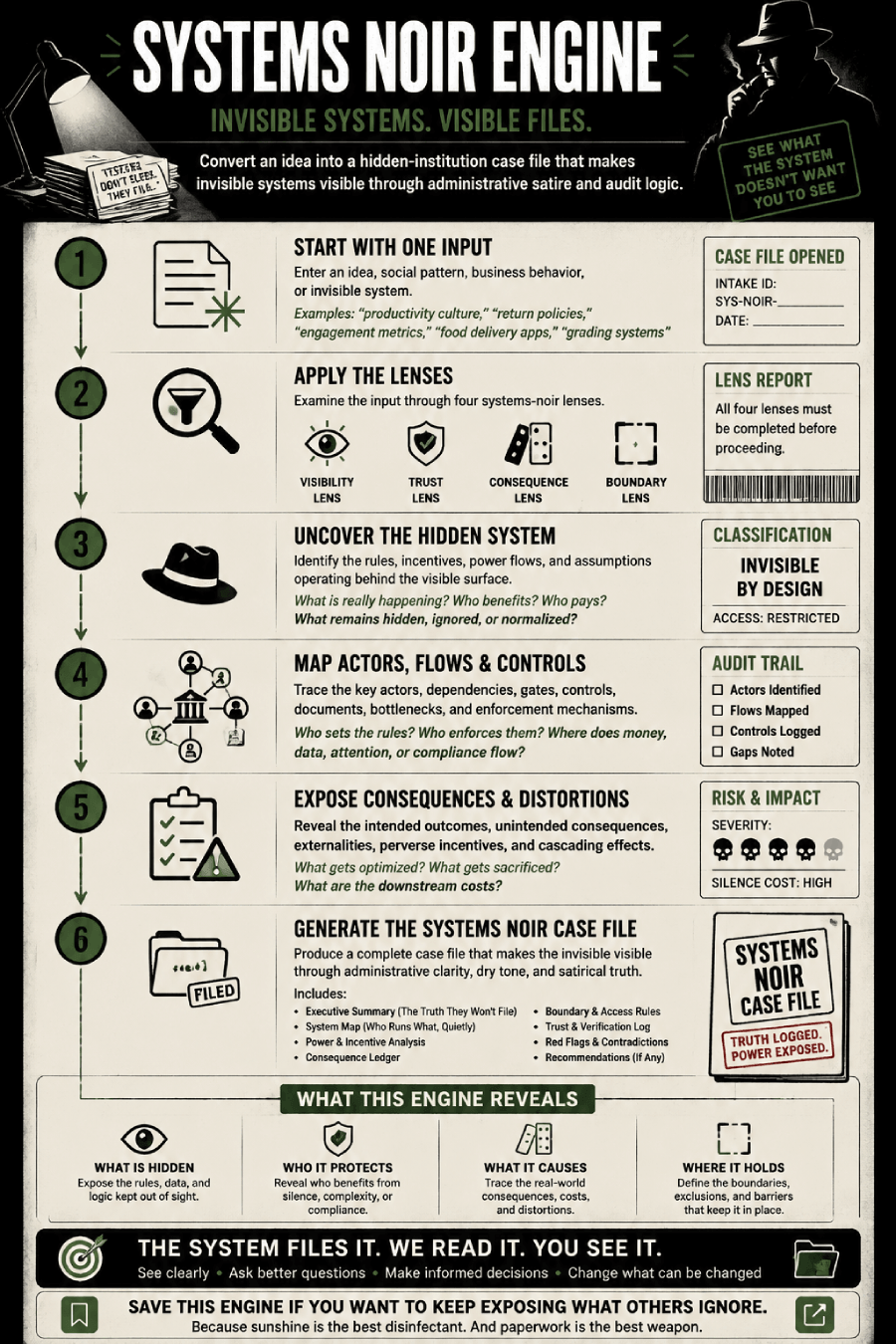
The Systems Noir Engine transforms ordinary ideas, social patterns, business behaviors, and hidden structures into investigative case files. Through administrative satire, audit logic, and institutional storytelling, it exposes the invisible systems quietly shaping reality.
The Most Powerful Systems Rarely Announce Themselves
Nobody wakes up thinking about queue management systems, reputation mechanisms, incentive structures, permission hierarchies, or expectation networks.
Yet these systems shape daily life.
They determine who gets attention, who gains access, which behaviors are rewarded, what information spreads, and how trust moves through society.
The reason they remain invisible is simple: successful systems disappear into normality.
People notice the line but not the queuing system. They notice the promotion but not the incentive architecture. They notice the policy but not the administrative logic beneath it.
The more ordinary a system appears, the harder it becomes to see.
Systems Noir Engines Turn Structures Into Investigations
A Systems Noir Engine reframes an idea as a hidden institutional case file.
Instead of asking, “How does this work?” it asks, “What department is secretly responsible for making this happen?”
This creates a useful fiction.
A social norm becomes the work of the Bureau of Behavioral Alignment. A customer loyalty program becomes an operation managed by the Department of Predictable Attachment. Corporate meetings become evidence collected by the Office of Distributed Responsibility.
The satire is intentional.
By treating invisible systems as auditable institutions, their logic becomes easier to examine. Assumptions become procedures. Incentives become policies. Consequences become documented side effects.
What was previously invisible becomes difficult to ignore.
Building a Systems Noir Case File
Every Systems Noir investigation examines the system through four lenses:
- Visibility Lens: What hidden mechanism is producing the visible outcome?
- Trust Lens: What assumptions or agreements allow the system to function?
- Consequence Lens: What predictable effects does the system generate over time?
- Boundary Lens: What rules determine who participates, who benefits, and who remains excluded?
The findings are compiled into a Systems Noir Case File.
A typical case file includes:
- Case Number: A designation for the investigated phenomenon.
- Institution of Origin: The fictional department responsible for maintaining the system.
- Official Function: The stated purpose of the system.
- Actual Function: What the system appears to accomplish in practice.
- Verification Procedures: How compliance is measured and reinforced.
- Observed Side Effects: The unintended consequences generated by normal operation.
- Audit Findings: The hidden logic discovered during investigation.
By presenting systems this way, the familiar becomes strange enough to analyze.
Satire Creates Visibility
Traditional analysis often struggles to make invisible systems memorable. People understand the explanation but quickly forget it.
Systems Noir works differently.
By combining audit language with institutional satire, it creates cognitive distance. Readers stop seeing a system as natural and begin seeing it as designed. Once that shift occurs, questions emerge automatically.
- Who benefits from this arrangement?
- What behavior is being rewarded?
- Why does this pattern persist?
- What happens if the system remains unchanged?
The Systems Noir Engine exists to provoke those questions. It treats everyday reality as a collection of hidden agencies, unofficial departments, and administrative mechanisms quietly directing outcomes behind the scenes.
Because the most interesting systems are rarely the ones everyone can see.
They are the ones operating so successfully that nobody remembers they were built at all.