
Finding Where Systems Are Quietly Approaching Their Limits
Most failures appear sudden. A team burns out. A workflow collapses. A relationship breaks down. A customer support queue explodes. An emotional reaction seems to come out of nowhere. But pressure rarely appears instantly. It accumulates.
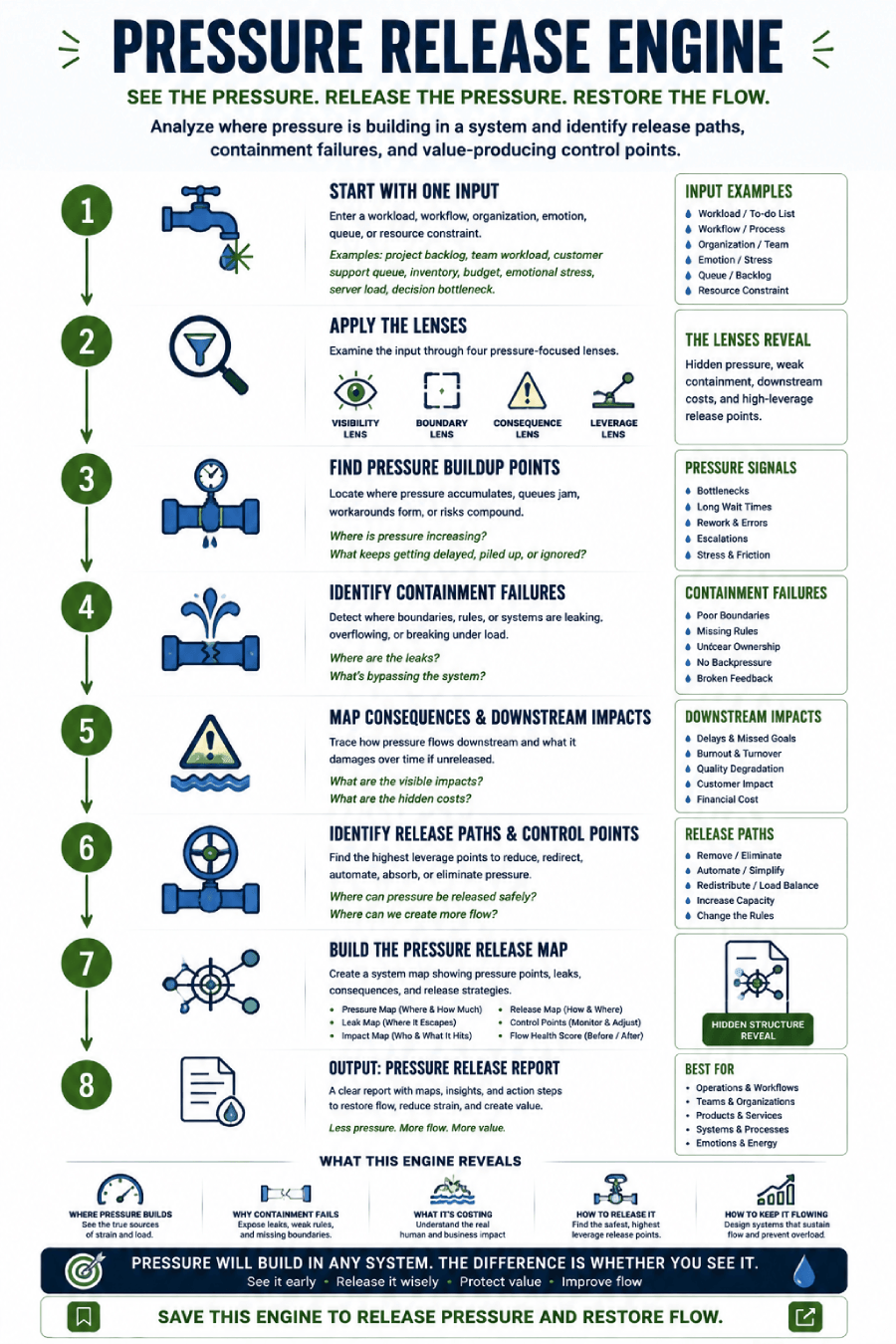
Long before visible failure occurs, energy, demand, responsibility, frustration, complexity, or constraint begins building inside the system. The Pressure Release Engine reveals where that pressure is gathering, why it is accumulating, and which release paths can prevent disruption while preserving system health.
Systems Usually Fail From Accumulation Before Failure
People often focus on breakdown events.
The missed deadline. The angry customer. The exhausted employee. The overloaded server. The emotional outburst.
Yet these events are often the final stage of a much longer process.
Pressure had been building long before anyone noticed.
A manager absorbs decisions faster than they can delegate them. A process collects exceptions faster than it can resolve them. A relationship accumulates unspoken frustrations. A queue receives requests faster than they are processed.
The visible failure is not the problem.
The visible failure is the pressure release.
The real story is the accumulation that occurred beforehand.
Pressure Release Engines Reveal Hidden Accumulation Dynamics
A Pressure Release Engine is a framework for identifying where pressure is building within a workload, workflow, organization, relationship, queue, emotional state, or constrained resource system.
Instead of asking, “What is failing?” it asks, “What pressure is being stored?”
This changes the investigation.
A bottleneck is no longer simply a delay. It becomes a pressure reservoir. An overloaded employee becomes a constrained release valve. A backlog becomes stored demand. A conflict becomes accumulated tension seeking an outlet.
Pressure is not inherently negative.
In many systems, pressure creates value.
Water pressure powers cities. Market pressure drives innovation. Deadlines create focus. Emotional pressure motivates change.
The challenge is not eliminating pressure.
The challenge is managing it.
Conducting a Hidden Structure Reveal
To understand pressure dynamics, examine the system through four lenses:
- Visibility Lens: Where is pressure accumulating that remains largely unseen?
- Boundary Lens: Which limits, rules, capacities, or constraints are containing the pressure?
- Consequence Lens: What becomes more likely if accumulation continues unchecked?
- Leverage Lens: Where could a small intervention release significant pressure or improve flow?
As these perspectives combine, a Hidden Structure Reveal begins to emerge.
The analysis identifies:
- Pressure accumulation points
- Existing release mechanisms
- Containment boundaries
- Emerging failure risks
- High-leverage intervention opportunities
What initially appeared to be a problem often reveals itself as a pressure management challenge.
Healthy Systems Release Pressure Before Failure
The strongest systems are not those that eliminate pressure.
They are those that regulate it.
A healthy organization distributes responsibility before overload occurs. A healthy workflow processes bottlenecks before queues become crises. A healthy relationship addresses tension before resentment accumulates. A healthy infrastructure system includes relief valves before pressure damages the network.
Pressure is inevitable.
Unmanaged pressure is optional.
The Pressure Release Engine helps make accumulation visible before disruption occurs. It reveals that most system failures are not caused by a single event. They are caused by pressure that had nowhere productive to go.
Because every system stores pressure somewhere.
The real question is whether that pressure is being released intentionally—or waiting to release itself.
Hidden Structure Reveal
Every Pressure Release Engine analysis should identify:
- Pressure Source: What is generating the accumulation?
- Pressure Reservoir: Where is pressure currently being stored?
- Containment Boundary: What is preventing immediate release?
- Failure Threshold: What happens if pressure continues to build?
- Release Paths: Which mechanisms can safely reduce pressure?
- Control Points: Where can small changes produce disproportionate relief?
The most resilient systems are not pressure-free. They are systems designed with intelligent release paths before pressure becomes a crisis.