
Choosing Futures, Not Just Outcomes
Most decisions appear to be choices between options. Choose Strategy A or Strategy B. Hire now or wait. Build internally or buy externally. But decisions are rarely about isolated outcomes. Every choice installs a different set of incentives, constraints, maintenance requirements, risks, and opportunities.
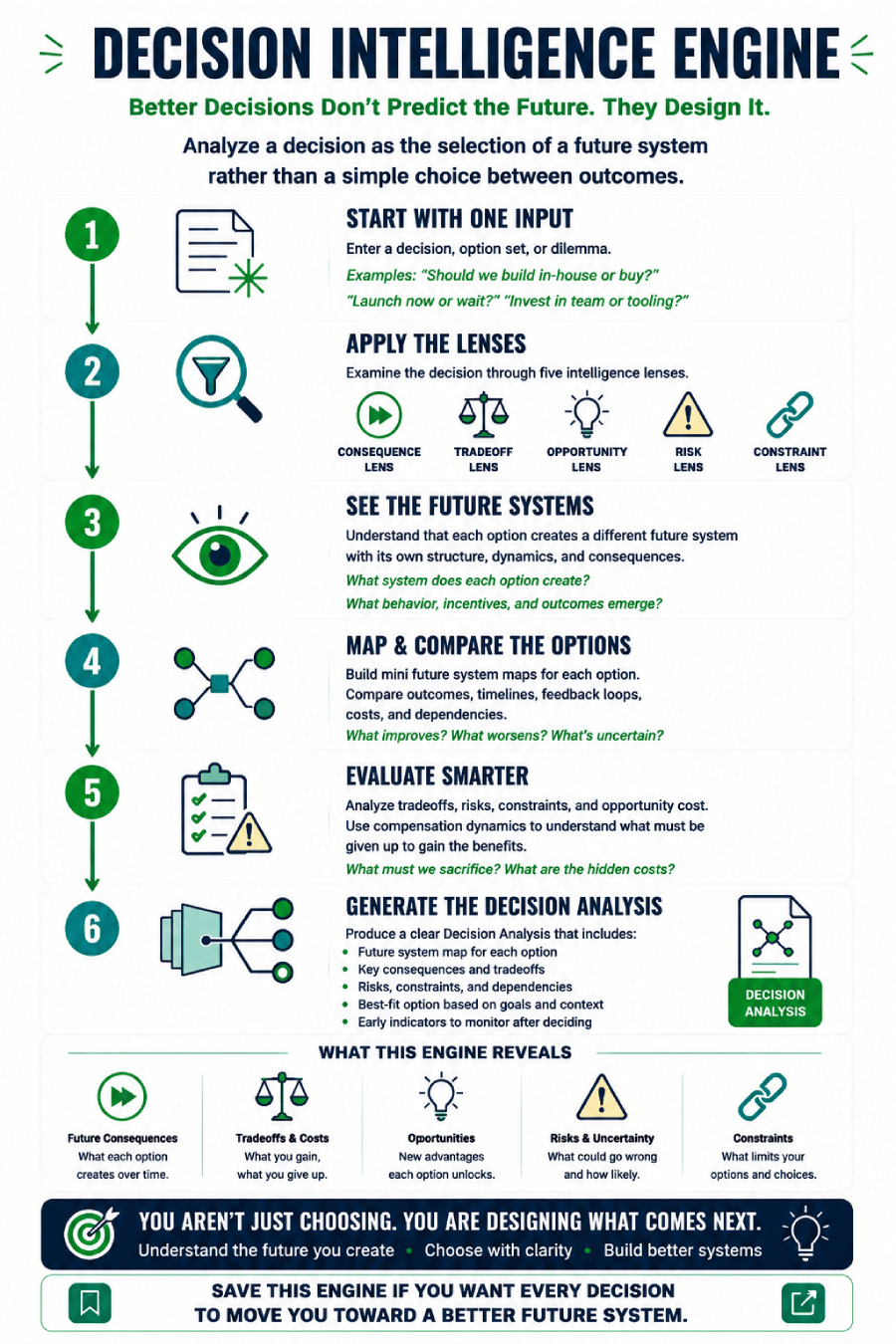
In effect, every decision selects a future system. The Decision Intelligence Engine helps reveal those systems so choices can be evaluated by the worlds they create, not just the results they promise.
Decisions Are More Than Outcome Selection
When faced with a decision, people often focus on the most visible consequence.
Which option generates the most revenue? Which path saves the most time? Which solution reduces the most risk?
These questions matter, but they only capture a fraction of what a decision actually does.
Every decision creates second-order effects. It changes workflows, redistributes resources, alters incentives, creates new dependencies, and removes alternative possibilities. The visible outcome is often only the first expression of a much larger system that begins forming after the choice is made.
The decision itself may take minutes. The system it creates may shape years.
Decision Intelligence Engines Reveal the Future Systems Behind Choices
A Decision Intelligence Engine is a framework for analyzing a decision as the selection of a future operating environment rather than a simple choice between outcomes.
Instead of asking, “Which option is best?” it asks, “What system does each option create?”
This shift transforms decision-making.
Hiring an employee is not simply adding capacity. It creates management requirements, communication pathways, cultural influence, and long-term obligations. Automating a process is not simply improving efficiency. It creates new dependencies, maintenance responsibilities, and operational constraints. Expanding into a new market is not simply increasing opportunity. It creates a new landscape of risks, competitors, regulations, and resource demands.
Every option is a future system waiting to be installed.
Conducting a Decision Analysis
To understand the systems embedded within a choice, evaluate each option through five lenses:
Consequence Lens: What direct and indirect effects are likely to emerge over time?
Tradeoff Lens: What advantages are gained, and what capabilities are sacrificed?
Opportunity Lens: What new possibilities become available if this path is chosen?
Risk Lens: What vulnerabilities, uncertainties, or failure points are introduced?
Constraint Lens: What future limitations, obligations, or dependencies does this option create?
As these perspectives accumulate, the decision becomes less about comparing outcomes and more about comparing future realities.
The question changes from “Which result do I want?” to “Which system do I want to live inside?”
The Best Decisions Optimize Future Conditions
Many poor decisions produce attractive short-term outcomes. Many strong decisions require accepting short-term costs in exchange for better long-term systems.
This is why decision quality cannot be judged solely by immediate results. A good outcome can emerge from a fragile system. A difficult outcome can emerge from a resilient one.
The Decision Intelligence Engine encourages a broader view. It treats every choice as a design decision that shapes future conditions, not merely future events.
When you understand decisions this way, options stop looking like isolated alternatives. They become competing system architectures. Each one carries its own opportunities, constraints, risks, and trajectories.
In the end, every decision answers the same hidden question: not “What outcome do I want?” but “What future system am I choosing to create?”