
Mapping the Outcomes Already Taking Shape Beneath Today’s Decisions
Most decisions are evaluated by their immediate effects. Did the initiative work? Did the process improve efficiency? Did the policy solve the problem? But systems rarely reveal their full consequences in the present moment.
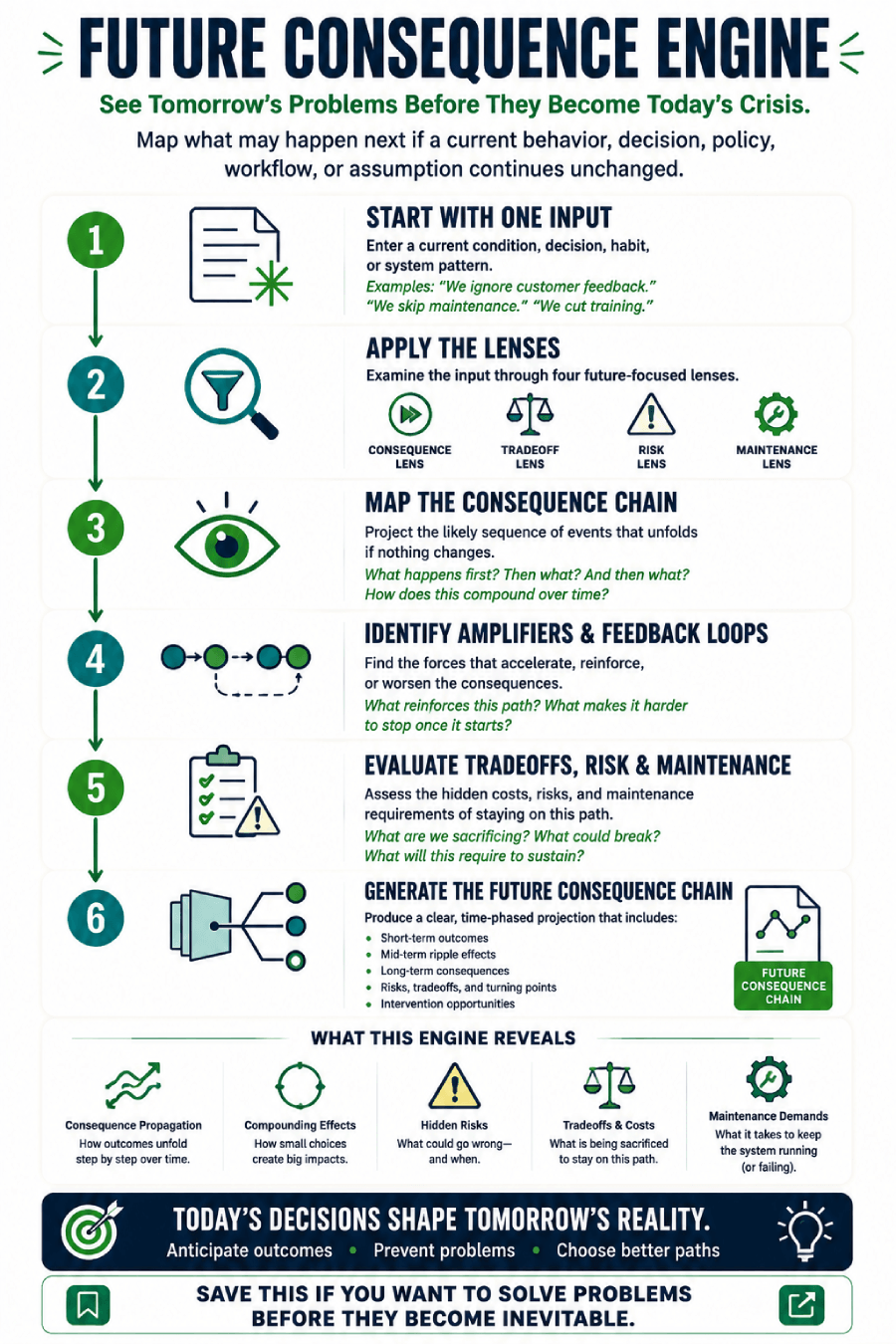
Many outcomes emerge slowly through accumulation, propagation, and compounding effects. The Future Consequence Engine helps make those future pathways visible, showing what may happen if a current behavior, decision, workflow, or assumption continues unchanged.
Today’s Conditions Are Already Creating Tomorrow’s Outcomes
People often think of consequences as future events. In reality, consequences begin forming the moment a pattern is established.
A neglected maintenance task becomes tomorrow’s outage. A small process inefficiency becomes next year’s operational bottleneck. A culture of rushed decisions becomes an organization that struggles with quality. A habit of avoiding difficult conversations becomes a team burdened by unresolved problems.
The future is rarely created by a single dramatic event. More often, it is shaped by patterns that quietly persist.
What feels harmless today may simply be too early to notice.
Future Consequence Engines Trace the Path of Continuing Patterns
A Future Consequence Engine is a framework for projecting the likely effects of a behavior, decision, policy, workflow, or assumption if it remains unchanged.
Rather than asking, “What happens now?” it asks, “What happens if this keeps happening?”
This shifts attention from isolated events to consequence propagation.
A workflow that saves time today may gradually increase complexity elsewhere. A policy designed to improve control may slowly reduce adaptability. A shortcut that appears efficient may accumulate hidden maintenance costs. Every system creates downstream effects, whether those effects are intended or not.
The goal is not prediction. The goal is visibility.
By understanding where a pattern naturally leads, better decisions become possible before consequences become unavoidable.
Building a Future Consequence Chain
To map the trajectory of a current condition, examine it through four lenses:
Consequence Lens: If this pattern continues, what direct outcomes become more likely over time?
Tradeoff Lens: What benefits are being gained now, and what costs are being deferred until later?
Risk Lens: Which vulnerabilities become larger, more difficult, or more expensive if left unaddressed?
Maintenance Lens: What future burden is being created by today’s choices?
These questions create a Future Consequence Chain—a sequence of likely effects that extends beyond the immediate outcome and reveals how consequences compound through a system.
The further downstream you look, the more visible the true cost—or value—of today’s decisions becomes.
Every Pattern Is a Forecast
Organizations often conduct forecasts for revenue, growth, and performance. Far fewer forecast the consequences of their habits, assumptions, and operating patterns.
The Future Consequence Engine fills that gap. It treats current behavior as evidence of a future trajectory. Instead of reacting to consequences after they appear, it identifies them while they are still forming.
The most valuable insight is often not what a system is doing today, but what it is quietly becoming.
Every repeated action creates momentum. Every maintained assumption shapes a direction. Every unresolved issue extends a chain of future effects.
When you learn to see those chains early, you gain the opportunity to alter the outcome before it arrives. The future is not hidden—it is often visible in the patterns we choose to continue.