
Seeing What a System Can—and Cannot—See About Itself
Every system learns through feedback. A business learns from customers. A team learns from results. A person learns from consequences. A product learns from usage patterns. But learning depends on visibility. If a system cannot perceive its own performance, mistakes, drift, and weaknesses remain hidden.
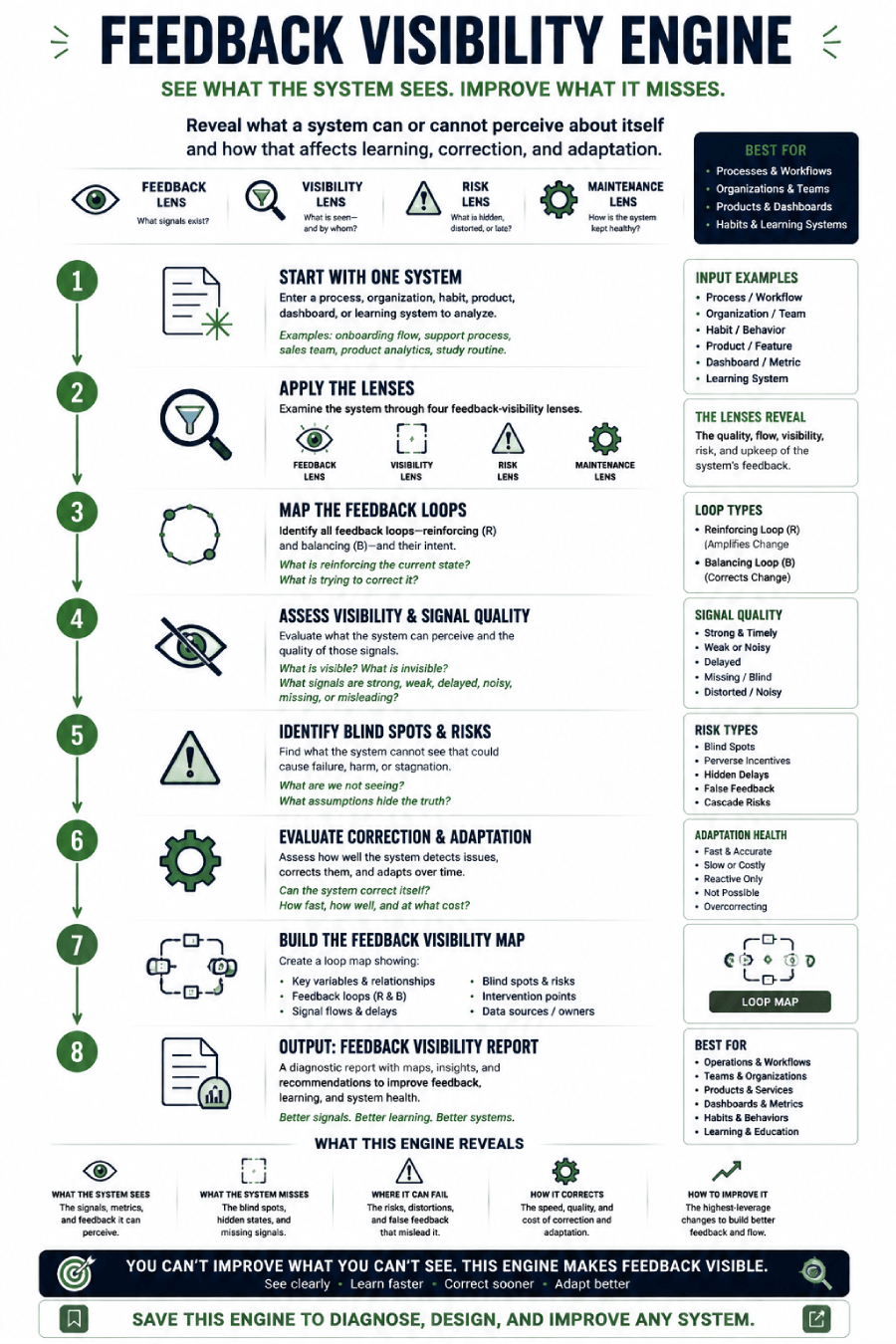
The Feedback Visibility Engine reveals what a system can and cannot see about itself, exposing the blind spots that shape adaptation, correction, and long-term success.
Systems Can Only Respond to Signals They Can Detect
Most organizations assume they are learning because information exists somewhere.
Customer complaints are collected. Metrics are tracked. Reports are generated. Dashboards are updated.
Yet information and visibility are not the same thing.
A company may gather customer feedback but only review it quarterly. A team may measure performance but track the wrong metrics. A person may experience recurring problems without recognizing the pattern connecting them.
The feedback exists.
The system simply cannot perceive it in a useful form.
When this happens, adaptation slows, mistakes repeat, and hidden risks accumulate.
The limitation is not intelligence.
The limitation is visibility.
Feedback Visibility Engines Reveal Perceptual Boundaries
A Feedback Visibility Engine is a framework for analyzing what a process, organization, habit, product, dashboard, or learning system can perceive about itself.
Instead of asking, “Is the system receiving feedback?” it asks, “What feedback is actually visible to the system?”
This distinction is critical.
A thermostat adapts because it can detect temperature changes. A pilot adjusts course because instruments reveal drift. A business improves because customer behavior becomes visible. A person grows because consequences become connected to actions.
Without feedback visibility, correction becomes guesswork.
The system continues operating, but it loses its ability to learn efficiently.
Building a Loop Map
To understand a system’s ability to learn, examine it through four lenses:
Feedback Lens: What signals currently inform the system about its performance?
Visibility Lens: Which important conditions, consequences, or changes remain hidden?
Risk Lens: What failures become likely because critical information is missing or delayed?
Maintenance Lens: What processes ensure feedback remains accurate, timely, and actionable?
As these questions accumulate, a Loop Map begins to emerge.
The analysis reveals:
- Available feedback signals
- Hidden blind spots
- Delayed or distorted feedback loops
- Learning constraints
- Opportunities to improve visibility and adaptation
The goal is not merely to collect more information.
The goal is to improve perception.
Adaptation Depends on What Can Be Seen
The most adaptive systems are not necessarily the smartest systems.
They are the systems with the clearest feedback loops.
A small organization with direct customer contact often learns faster than a large organization buried beneath layers of reporting. An athlete improves because performance feedback is immediate. A craftsman develops expertise because errors become visible during the work itself.
Learning speed is often determined by feedback visibility.
The faster a system can detect reality, the faster it can adjust to reality.
The Feedback Visibility Engine helps uncover where that process breaks down. It reveals that many failures are not caused by poor decisions but by missing signals. The system is operating with incomplete awareness of itself.
Because every system is continuously asking a question:
“How am I doing?”
The quality of the answer depends entirely on what it is able to see.
Loop Map
Every Feedback Visibility Engine analysis should identify:
Visible Signals: What feedback is currently available?
Invisible Conditions: What important information remains hidden?
Signal Delays: How long does feedback take to become visible?
Learning Constraints: What prevents correction or adaptation?
Feedback Distortions: Where are signals inaccurate, filtered, or misleading?
Visibility Upgrades: What changes would improve learning and self-correction?
The most resilient systems are not those that avoid mistakes. They are the ones that can see mistakes quickly enough to learn from them.