
Making Writing Feel Lived, Not Manufactured
Most writing communicates information. Human writing communicates experience. It carries observation, perspective, uncertainty, preference, memory, and personality. You can often feel the difference immediately.
One piece sounds technically correct but emotionally empty.
The other feels like it came from someone who has actually seen the thing they are describing. The Human Writer Engine transforms generic text into something more human by reintroducing the qualities that make readers feel they are hearing from a person rather than a system.
Information Alone Rarely Feels Human
Many modern writing systems optimize for clarity, efficiency, and completeness.
The result is often competent but forgettable.
The sentences are clean. The structure is logical. The explanations are accurate. Yet something feels missing.
What disappears is the texture of human experience.
People rarely think in perfectly balanced paragraphs. They notice strange details. They hold contradictory opinions. They remember specific moments. They make comparisons that reveal how they see the world. They laugh at things they shouldn’t. They change their minds.
Human writing contains evidence of a person behind the words.
When that evidence disappears, the writing may remain useful, but it stops feeling alive.
Human Writer Engines Restore the Signals of Human Thought
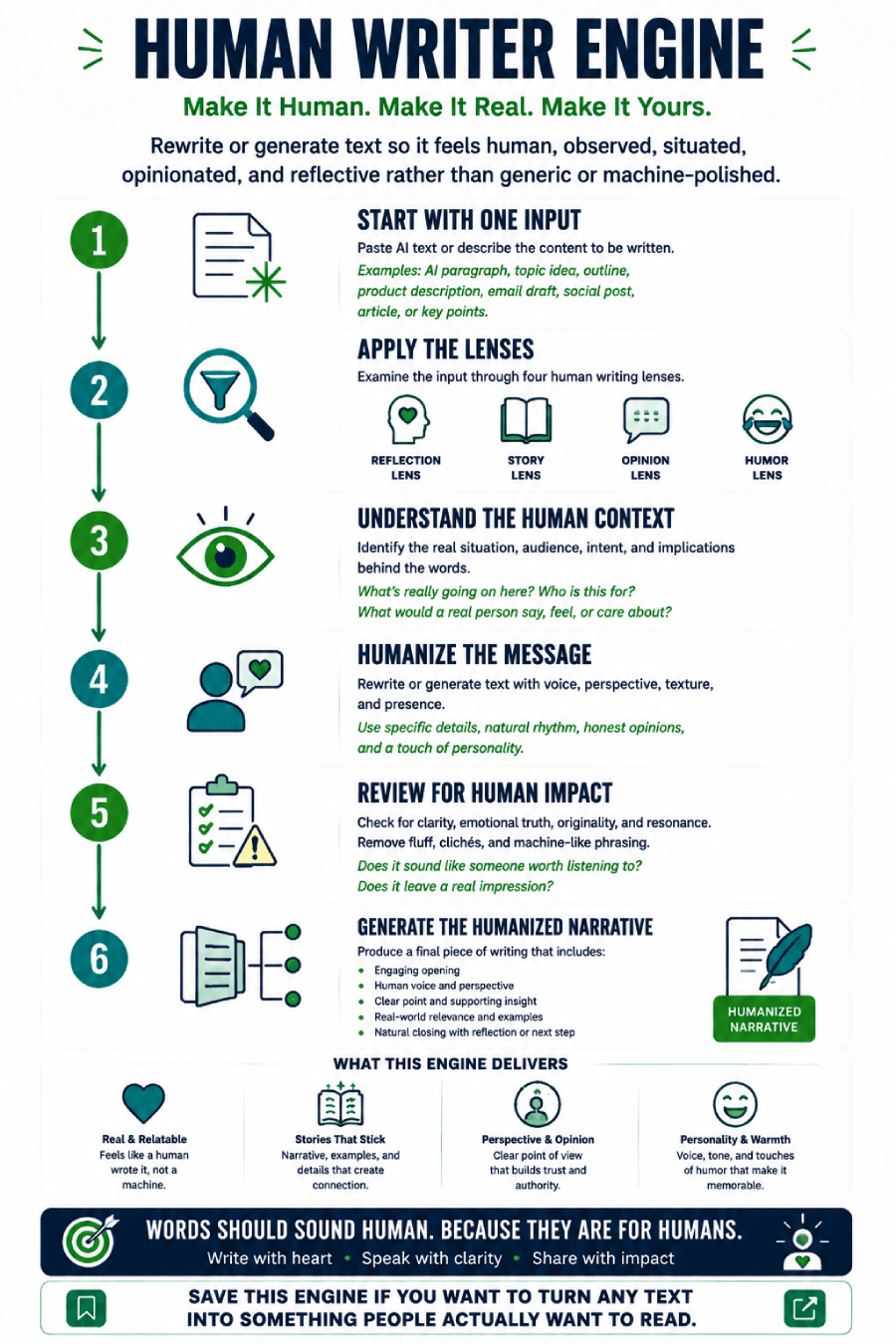
A Human Writer Engine is a framework for rewriting or generating text so it feels observed, situated, reflective, opinionated, and distinctly human.
Instead of asking, “Is this clear?” it asks, “Does this sound like it came from someone who has actually encountered this?”
This changes the goal of writing.
The objective is no longer perfect neutrality. It is believable perspective.
A restaurant review becomes stronger when it includes the detail that everyone seemed to order the same dish. A business article becomes more memorable when it admits that a common assumption turned out to be wrong. A reflection becomes more engaging when it contains uncertainty instead of certainty.
Humanity enters through specificity.
The reader begins to sense a real observer behind the narrative.
Building a Humanized Narrative
To make writing feel more human, examine it through four lenses:
- Reflection Lens: What personal observation, realization, or change in perspective can be added?
- Story Lens: What moment, example, memory, or scene makes the idea tangible?
- Opinion Lens: What genuine judgment, preference, disagreement, or interpretation belongs here?
- Humor Lens: Where can lightness, irony, contrast, or self-awareness create connection?
As these elements accumulate, a Humanized Narrative begins to emerge.
The narrative contains:
- Specific observations instead of abstractions
- Experiences instead of summaries
- Perspectives instead of generic neutrality
- Reflection instead of information alone
- Personality instead of polished uniformity
The goal is not to sound casual. The goal is to sound inhabited.
Readers Connect With People, Not Perfect Sentences
The strongest writing often contains imperfections that reveal authenticity.
A surprising observation. An unexpected opinion. A small detail that could only come from lived experience.
These signals create trust because they remind readers that a person is present behind the words.
The Human Writer Engine helps restore those signals. It treats writing not as the transfer of information but as the transfer of perspective. Facts matter, but facts alone rarely create connection. People remember the interpretation attached to the information. They remember the observation that changed how they saw something. They remember the voice.
Because in the end, readers are not simply looking for answers. They are looking for evidence that another human has been there, noticed something worth sharing, and taken the time to tell the story in a way only they could.
Humanized Narrative
Every Human Writer Engine output should answer five questions:
- What was actually observed?
- What personal perspective makes this interpretation unique?
- What specific detail makes the idea believable?
- What reflection transforms information into insight?
- What human quality—curiosity, humor, doubt, conviction, surprise—makes the writing memorable?
The difference between generic writing and human writing is rarely intelligence. It is presence. The reader should feel that someone is in the room with them, thinking aloud on the page.