
How Everyday Objects Reveal the Systems Hidden in Plain Sight
Most people see objects as things. Systems thinkers see them as evidence. A coffee mug, a bridge, a notebook, a key, or a worn-out pair of shoes may appear ordinary, but each contains traces of invisible systems, human behaviors, accumulated decisions, and enduring principles.
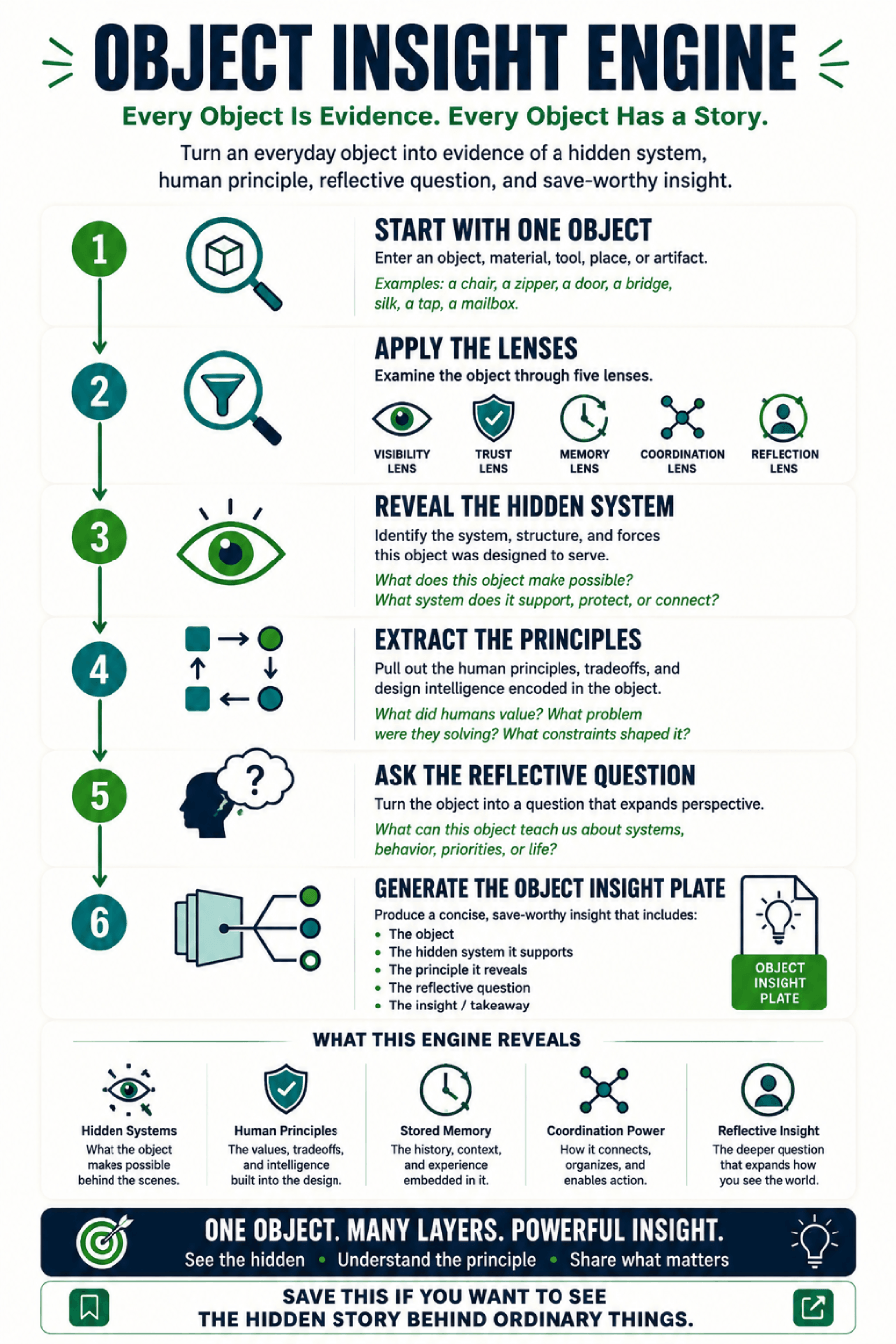
The Object Insight Engine transforms everyday artifacts into lenses for understanding the structures that shape our lives.
Objects Are Frozen Evidence of Invisible Systems
Every object exists because a system made it necessary.
A key exists because trust has boundaries. A calendar exists because memory is imperfect. A bridge exists because separation creates friction. A notebook exists because ideas disappear when left unmanaged.
Yet most people stop at function. They see what an object does rather than what it reveals.
Objects are not merely tools. They are physical evidence of recurring human needs, constraints, and coordination problems. They are solutions that survived long enough to become familiar. Familiarity hides significance.
The more ordinary an object becomes, the easier it is to overlook the system that produced it.
Object Insight Engines Convert Artifacts Into Understanding
An Object Insight Engine takes an object and extracts four layers of meaning from it.
- The first layer is the visible function. What practical purpose does it serve?
- The second layer is the hidden system. What recurring challenge, dependency, or coordination problem made this object necessary?
- The third layer is the human principle. What enduring truth about people does this object embody?
- The fourth layer is the reflective insight. What question does the object quietly ask about how we live, work, or think?
What begins as observation becomes interpretation. What begins as a thing becomes a lesson.
Building an Object Insight Plate
To uncover deeper meaning, examine the object through five lenses:
Visibility Lens: What hidden problem becomes visible through this object’s existence?
Trust Lens: What relationship, expectation, or social agreement does it support?
Memory Lens: What does this object preserve, record, or prevent from being forgotten?
Coordination Lens: How does it help people align actions, decisions, or resources?
Reflection Lens: What larger question about human behavior does it invite us to consider?
The result is an Object Insight Plate—a compressed framework that transforms a simple artifact into a memorable insight worth saving, sharing, and revisiting.
The Smallest Objects Often Carry the Largest Lessons
The most powerful insights rarely come from extraordinary things. They come from ordinary things examined deeply.
A key becomes a lesson about trust. A map becomes a lesson about uncertainty. A clock becomes a lesson about coordination. A mirror becomes a lesson about self-perception. Every object carries a hidden story about the problem it was designed to solve.
Object Insight Engines train us to see those stories. They reveal that artifacts are not merely products of human thought—they are records of it. When you learn to read the systems embedded within everyday objects, the world becomes less a collection of things and more a library of accumulated wisdom waiting to be noticed.